- Get in Touch
- +91 96840 33261
- Location
- Pune Maharashtra India
- Mail Us
- sales1@swizasafetech.in
Robot Safety Fencing: A Complete Guide for Factory Automation in 2025
- Swiza Safetech
- August 21, 2025
- 500 Views
In 2025, factory automation has reached unprecedented levels, with robotic systems taking center stage across industries from automotive to electronics. While these machines drive productivity, they also introduce complex safety risks. One of the most critical components of a safe and efficient automated factory floor is robot safety fencing. At Swiza Safetech, we understand the importance of protecting both people and machinery in an increasingly automated world.
This guide explores how safety fencing supports modern automation goals, what standards apply in 2025, and how you can implement the right system for your industrial needs.
Why Robot Safety Fencing Is More Critical Than Ever
As automation becomes more integrated into manufacturing workflows, human-robot interaction has increased. Even with the growth of collaborative robots (cobots), traditional industrial robots still dominate large-scale production environments. These machines move at high speeds and can handle heavy materials, posing a serious threat if operators accidentally enter their work envelope.
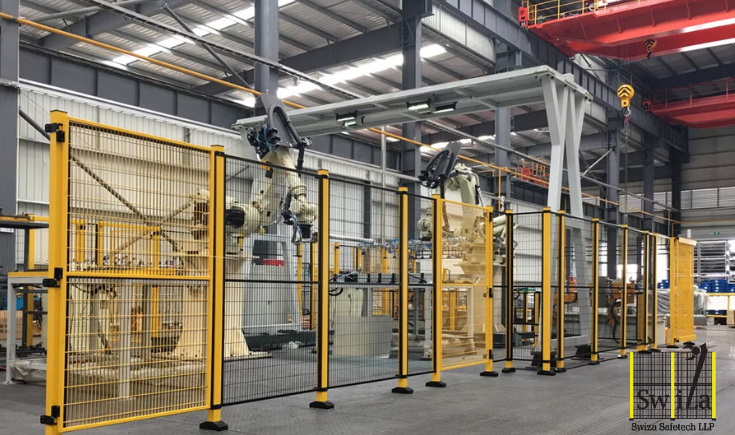
Robot safety fencing serves as a physical and visual barrier between dangerous robot operations and human workers. It is designed not only to prevent entry into hazardous zones but also to restrict access until conditions are safe. In 2025, with intelligent systems and AI-driven robots operating continuously, having robust, reliable, and flexible fencing systems is non-negotiable.
Core Functions of Safety Fencing in Robotic Cells
Safety fencing plays multiple roles in ensuring the smooth operation of a robotic cell. It protects human workers from injury, minimizes the risk of equipment damage, and ensures that production lines comply with international safety regulations.
Modern safety fencing solutions integrate with sensors, interlocks, and control systems. These components work together to detect unauthorized access or when a gate is opened during operation. As a result, robots can be automatically stopped or slowed, minimizing harm and ensuring compliance.
Key Regulatory Standards in 2025
Compliance remains a central concern in robot safety planning. In 2025, updated global and regional standards set the framework for how robotic systems must be guarded. ISO 10218 and ISO/TS 15066 remain foundational, especially for collaborative environments, while ANSI/RIA R15.06 continues to guide installations in North America.
In Saudi Arabia and across the Middle East, safety standards have become more closely aligned with European and international frameworks. The adoption of CE-marked components and ISO-compliant safety systems is now widespread. This shift ensures that automation systems meet global safety benchmarks and remain legally defensible in case of incidents.
Choosing fencing systems
that adhere to these standards is essential. Swiza Safetech’s solutions are fully compliant with the latest requirements, offering peace of mind for both manufacturers and system integrators.
Choosing the Right Fencing System for Your Factory
The right robot safety fencing depends on several factors: the size of the robot cell, the speed and force of the robot, the type of material handling involved, and the frequency of human interaction required. Fixed perimeter guarding is ideal for high-speed or dangerous robotic tasks where no human should enter the zone during operation.
For environments requiring regular maintenance or manual loading/unloading, modular fencing systems with safety interlocked gates and access panels offer both flexibility and protection. In 2025, smart fencing systems are increasingly used, integrating sensors and real-time alerts to notify operators of any breach or malfunction.
Integrating Safety Fencing with Automation Systems
Today’s factories demand connectivity, and safety systems are no exception. Advanced safety fencing can now integrate directly with PLCs and industrial control systems. This integration allows for smarter control of the robotic cell, including predictive maintenance, auto-shutdowns in case of access violations, and compliance logging.
Swiza Safetech offers fully integrated
safety fencing solutions
that connect seamlessly with automation hardware. Whether you're running a small CNC station with a cobot or a full-scale automotive assembly line, integration ensures that safety never becomes an afterthought.
Benefits Beyond Safety
While the primary role of safety fencing is to protect workers, the benefits extend further. Properly installed safety barriers reduce downtime caused by accidents, lower insurance liabilities, and boost worker confidence. Workers who feel safe are more productive and less prone to errors. Additionally, well-designed fencing improves workplace organization and aesthetic appeal, which are important in lean manufacturing environments.
Looking Ahead: The Future of Robot Safety
With the continued rise of AI and autonomous systems, the role of human oversight is evolving. Safety fencing will remain relevant—not just as a passive barrier but as an active, intelligent component of the factory of the future. From biometric access control to dynamic locking systems, the innovation in this field is accelerating.
Swiza Safetech is at the forefront of this evolution. Our mission is to design safety systems that not only meet current needs but also anticipate the challenges of tomorrow’s automation.
Final Thoughts
Robot safety fencing
is no longer a basic precaution—it is a strategic investment in operational continuity, worker safety, and regulatory compliance. As we move deeper into 2025 and beyond, factories that prioritize integrated, intelligent safety solutions will be the ones that lead the way in productivity and innovation.
Swiza Safetech is proud to support manufacturers in building safer, smarter, and more efficient production environments. Contact us today to learn how our safety fencing solutions can future-proof your automation systems.
Latest Post


