- Get in Touch
- +91 96840 33261
- Location
- Pune Maharashtra India
- Mail Us
- sales1@swizasafetech.in
The Role of Safety Fencing in Automated Manufacturing Plants
- Swiza Safetech
- August 8, 2026
- 210 Views
As manufacturing industries shift toward increased automation and high-speed robotic integration, the landscape of the factory floor is changing. While automation boosts productivity and consistency, it also introduces new risks for personnel. At Swiza Safetech, we believe that the integration of advanced safety fencing is not just a secondary requirement—it is a foundational pillar of modern industrial operations.
In this post, we explore the critical role that robust safety fencing plays in safeguarding both employees and assets in automated manufacturing environments.
1. Establishing a Human-Machine Interface
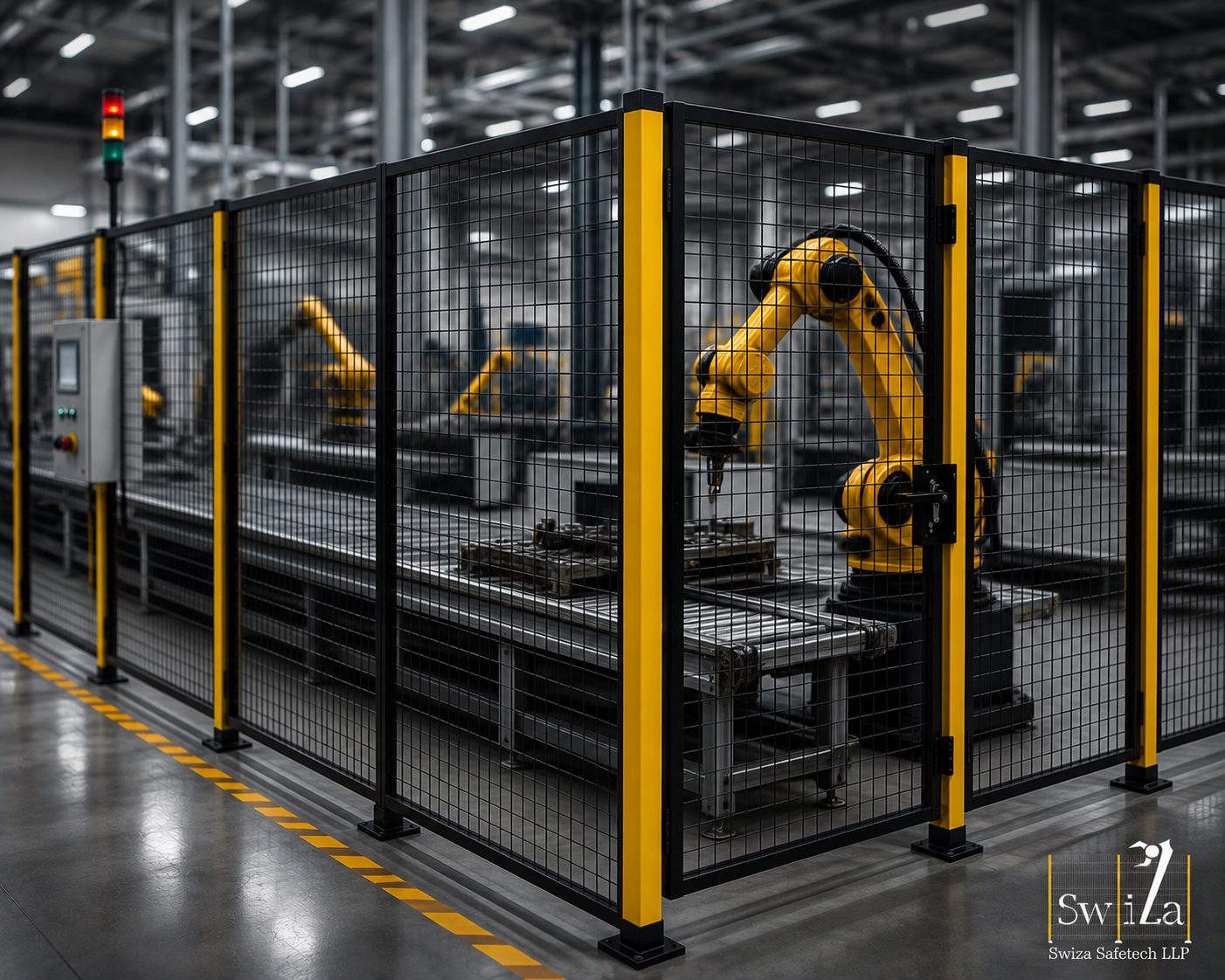
In an automated plant, robotic arms and moving machinery operate at speeds and force levels that can be lethal to humans. The primary role of safety fencing is to create a clear, physical demarcation between active work zones and human-accessible aisles.
By defining these boundaries, fencing prevents unauthorized entry and accidental contact, ensuring that employees are kept at a safe distance from dynamic mechanical parts while still being able to observe the manufacturing process.
2. Ensuring Compliance with Safety Standards
Safety is governed by rigorous global and local standards. As a leading manufacturer in Pune, Swiza Safetech ensures our designs meet essential criteria like ISO 14120, which outlines the design and manufacture of fixed and movable guards.
Installing compliant fencing ensures your facility meets industrial health and safety audits. It demonstrates a commitment to legal compliance and, more importantly, to the highest standards of workplace well-being.
3. Containment of Operational Hazards
Automated manufacturing often involves processes like high-speed CNC machining, laser welding, or automated assembly, which can generate flying debris, sparks, or chemical coolants.
High-quality mesh fencing serves a dual purpose:
-
● Protection: It keeps personnel safe from projectiles or harmful splashes generated by machinery.
-
● Containment: It keeps the workspace clean by preventing dust and debris from spreading into clean areas of the facility, which could otherwise interfere with sensitive production processes.
4. Improving Operational Efficiency
It may seem counterintuitive, but safety fencing actually improves productivity. In many automated plants, sensitive sensors and emergency stop (e-stop) systems are triggered when a human comes too close to a robot.
By securing the zone with fencing, you ensure that the machinery continues its work cycle without human interference, maintaining maximum output.
Without effective fencing, unauthorized movement can cause "e-stop" events leading to:
-
● Lost production time: Constant resetting of machinery eats into operational hours.
-
● Mechanical wear: Frequent start-stop cycles put unnecessary strain on expensive robotic components.
Benefits of Industrial Safety Fencing
-
● Reduced Liability: Lowers the risk of workplace accidents, significantly reducing insurance and legal exposure.
-
● Modular Flexibility: Modern fencing systems are modular, allowing them to be reconfigured as your production floor layout evolves.
-
● Enhanced Visibility: Mesh designs allow supervisors and operators to monitor machinery status without needing to enter the danger zone.
Conclusion
The transition to an automated factory is a significant investment in technology. However, that technology must be supported by equally sophisticated safety infrastructure. Safety fencing serves as the essential bridge between high-efficiency robotic automation and human security.
At Swiza Safetech, we provide durable, certified fencing solutions designed to integrate seamlessly into your automated workflows. Investing in professional-grade safety fencing is an investment in your company’s longevity and your employees' peace of mind.
Contact Swiza Safetech today to assess your factory floor and learn how our customized, modular fencing solutions can secure your automated manufacturing operations.
Latest Post

- Sep 29, 2023
- Sep 29, 2023
Exploring the Benefits of Robotics Fencing in Industrial Safety
Explore More
- Sep 26, 2023
- Sep 26, 2023
Exploring the Benefits of Robotics Fencing in Industrial Safety
Explore More
- Sep 15, 2023
- Sep 15, 2023
