- Get in Touch
- +91 96840 33261
- Location
- Pune Maharashtra India
- Mail Us
- sales1@swizasafetech.in
40x40 vs 40x60 Column Fencing: Choosing by Height, Span, Impact and Floor Fixing
- Swiza Safetech
The choice between 40x40 vs 40x60 column fencing comes down to how much load each post must carry and transfer into the floor. A 40x40 column fencing system suits most standard-height machine guarding, conveyor fencing and warehouse partitions where panel spans are moderate and impact risk is low. The 40x60 column series is the better choice when the fence is taller, panels are wider, the hazard behind the fence can strike or push against it (robot payloads, palletizer loads, forklift traffic), or the floor offers a less reliable anchorage.
Both belong to the same modular safety fencing system, built from common steel mesh safety panels, doors and connectors. Many layouts therefore use both: 40x40 on the general perimeter and 40x60 at door frames, corners and high-risk faces. The sections below explain each deciding factor in practical engineering terms.
What a modular machine guarding system is made of
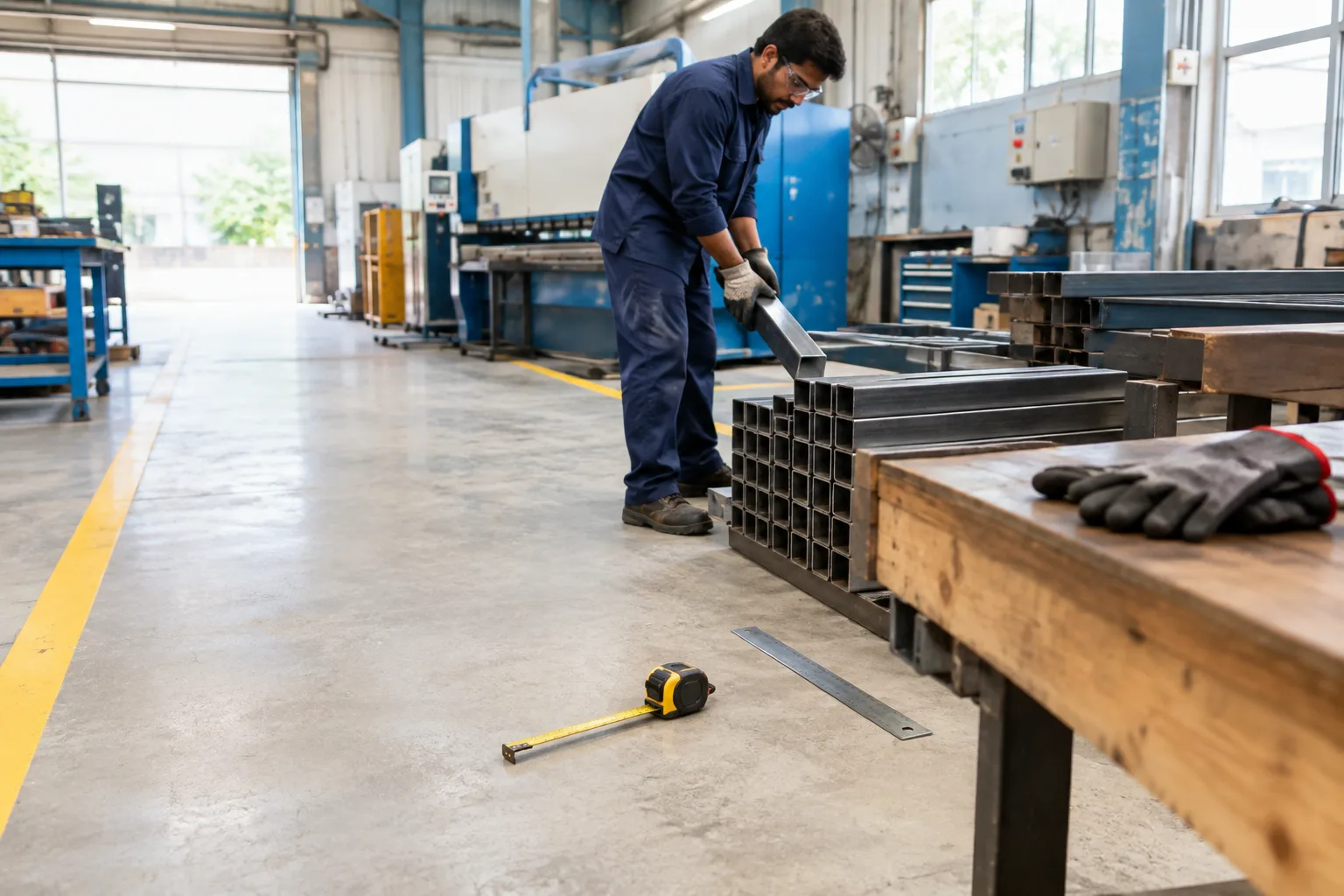
A modular machine guarding system is a set of standard components that bolt together on site, rather than a one-off welded enclosure. Swiza Safetech manufactures its range at Bhosari MIDC, Pune, and it includes:
- Columns in the 40x40 column series and 40x60 column series, with base plates for floor anchoring.
- Steel mesh safety panels, including 20x100 industrial wire mesh panels, with a published 20x100x3 mm mesh specification for the applicable product.
- Safety fencing doors and accessories: single-hinge, double-hinge and folding doors, locks and connectors.
- Powder-coated finishes in multiple colours, subject to product specification.
Because the parts are standard, modular machine guards can be extended, shortened or relocated when a line changes. This is why many plants now treat modular fencing systems as the default for automated cells and conveyor lines.
How do modular machine guarding systems compare to traditional ones?
Traditional guarding is usually fabricated for one machine: tube or angle frames welded on site, sheet or mesh infill, and fixings that are difficult to undo. It can fit an awkward machine closely, but it is slow to modify and quality varies between fabricators. A modular safety fence uses repeatable columns, panels and connectors, so dimensions, finish and fixings stay consistent, installation is quicker, and the fence can be reconfigured or reused. Where a machine shape is genuinely unusual, the two approaches are often combined. We compare them in more depth in traditional vs modular safety fencing systems and in our guide to custom vs modular machine guards.
Choosing by fence height
A fence column behaves like a cantilever fixed at the floor. Any sideways load near the top, whether a person leaning, a trolley striking the panel or a part hitting the mesh, creates a bending moment at the base that increases with height. A 40x60 column has a deeper section in its 60 mm direction, which gives it more bending stiffness in that axis than a 40x40 column of comparable wall thickness. In practice:
- For the standard machine guarding heights listed in our published catalogue, 40x40 is the usual choice for conveyors, test rigs, inspection stations and partitions.
- For taller perimeter guarding, or fences that also carry signage, cable trays or sensor brackets, consider 40x60, at least at the more heavily loaded positions.
Height is not only a structural decision. It must work together with the distance from the fence to the hazard. ISO 13857 sets safety distances to prevent upper and lower limbs from reaching danger zones, and the required fence height depends on that distance. Fix the height from your risk assessment and guarding design first, then select the column series that holds that height rigidly.
Choosing by panel span
Panel width sets the spacing between columns. Wider panels mean fewer columns and a cleaner layout, but each column collects load from a larger area of mesh, and the panel deflects more when pushed at mid-span. Our catalogue lists standard panel widths, which are the starting point for any layout.
- Shorter spans on 40x40 columns give a stiff fence with modest material, well suited to conveyor safety fencing that follows a long or winding line.
- Longer spans, and spans beside doors where the column also carries hinge loads, benefit from 40x60 columns.
Door posts deserve particular attention. A double-hinge or folding door loads its hinge column every time it swings, and an undersized post can deflect over time, misaligning locks and interlock switches. Using 40x60 columns at door frames, even within an otherwise 40x40 layout, is a common and sensible compromise.
Choosing by impact risk
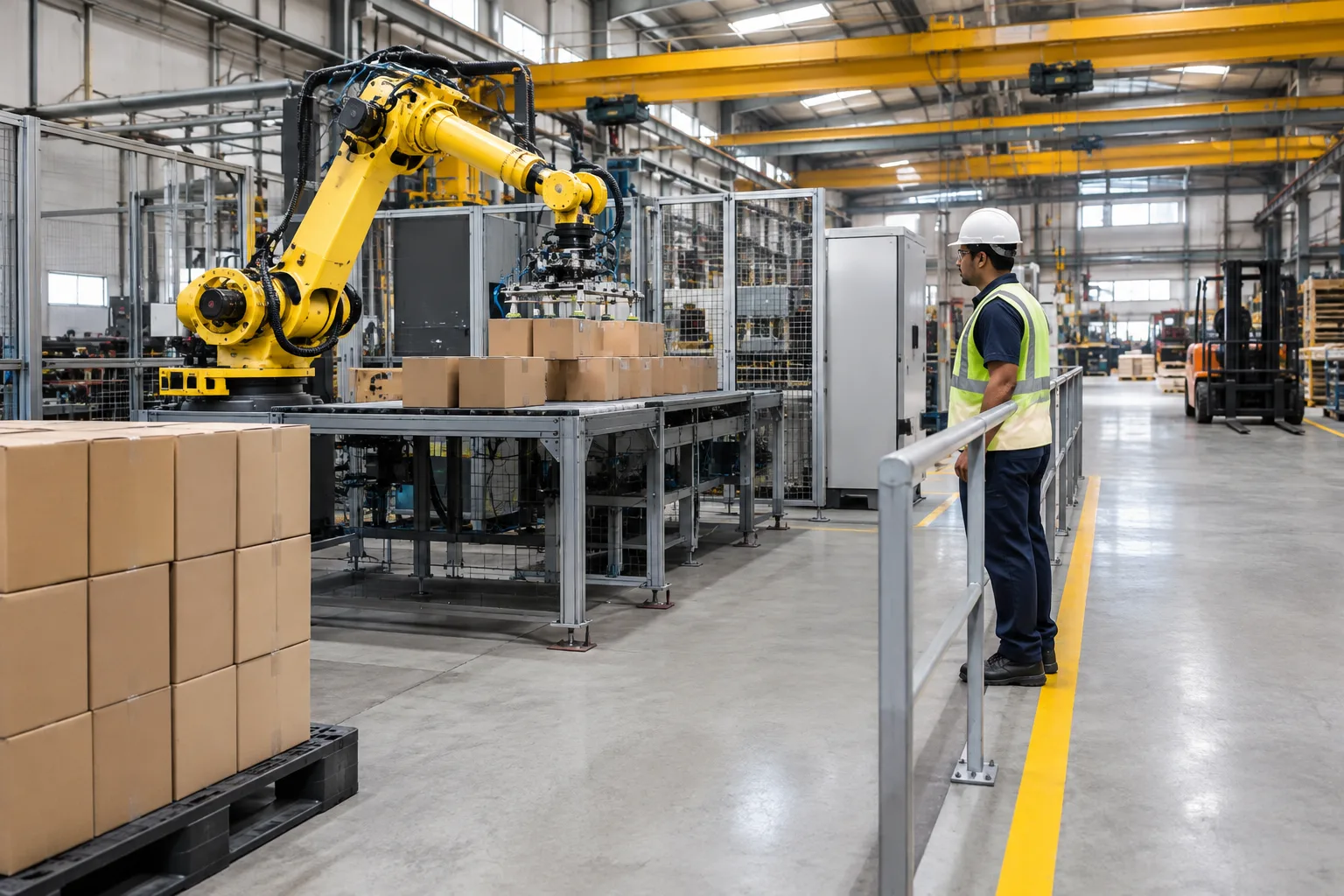
ISO 14120:2015 sets general requirements for the design and construction of fixed and movable guards, including that guards withstand the foreseeable forces from the machine and its surroundings, such as ejected parts. Impact is therefore the factor most likely to move a project towards 40x60.
Ask what could realistically strike the fence: a robot losing grip on a payload, a palletizer pushing a load, a forklift in the adjacent aisle, or an ejected workpiece. Swiza Safetech publishes ARAI impact-testing information for specified 40x40 and 40x60 fencing configurations under ARAI inspection reference FMCE/3100015707(22-23)/SS/548(22-23). Those results apply to the tested configurations, not automatically to every layout, so the impact expected in your application should be reviewed against them during design.
For robotic cell safety fencing with heavier payloads, palletizing cells and fences beside forklift routes, 40x60 columns are usually the starting point. For light assembly, inspection areas and modular warehouse partition fencing away from vehicle traffic, 40x40 is normally adequate. Fencing alone does not stop a robot: range limits, safety-rated controls and interlocked access remain part of the complete safety design.
Choosing by floor fixing conditions
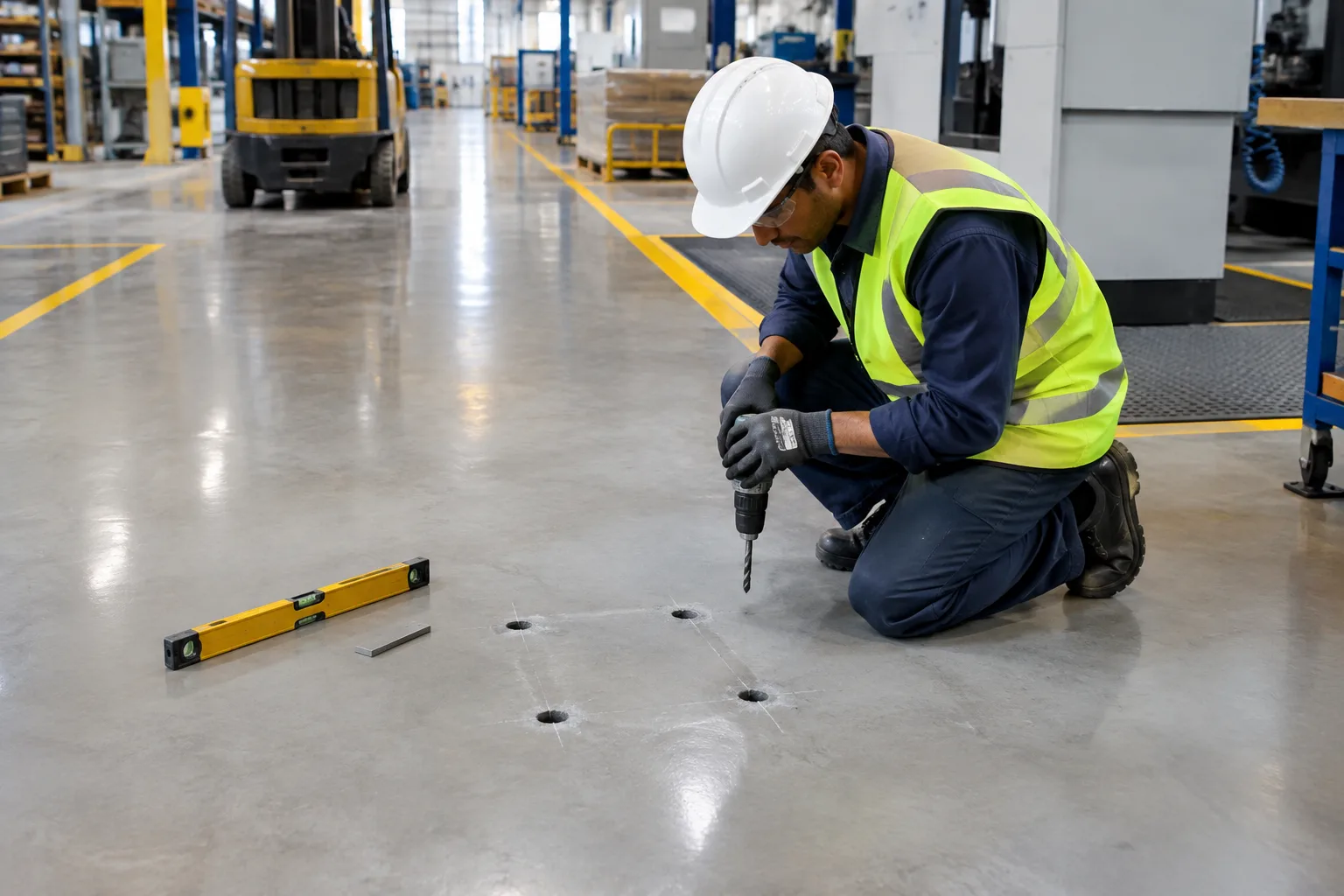
A column is only as strong as its anchorage. Before settling on the series, check the floor:
- Slab condition: cracked, thin or patched concrete holds anchors less reliably. A stiffer column on a suitable base plate spreads load more effectively.
- Coatings and toppings: epoxy or screed layers over the structural slab affect the effective anchor embedment.
- Trenches, pits and expansion joints: columns near these need careful positioning and sometimes a stiffer section to bridge a longer span.
- Uneven floors: older shop floors in Bhosari, Pimpri-Chinchwad and Chakan often need packing at base plates, which effectively lengthens the cantilever.
Where the floor is weak and the impact risk is high, moving to 40x60 at the affected positions is often simpler than adding extra columns or reworking the slab, although anchor selection still has to suit the concrete.
40x40 vs 40x60 column fencing: a quick selection guide
- Standard height, moderate spans, low impact, sound floor: 40x40.
- Taller fence or longer spans: 40x60, or 40x60 at the loaded positions.
- Door frames and hinge posts: consider 40x60.
- Robot payloads, palletizers or forklift exposure: start with 40x60 and review against the tested configurations.
- Weak or uneven floor: 40x60 with anchorage matched to the slab.
Many projects for plants across Chakan, Talegaon and Ranjangaon end up as mixed layouts, which keeps cost proportionate to risk on each face of the fence.
Reconfigurable modular fencing: planning for layout changes
Production layouts change, and the column series you choose today affects how much of the fence you can reuse tomorrow. If a cell is likely to receive a larger robot or a faster palletizer, specifying 40x60 on the exposed faces now allows that section to stay in place after the upgrade. Standard mesh panels, doors and connectors can usually be moved to a new position, which is the main practical advantage of reconfigurable modular fencing over welded guarding. Keep a marked-up layout of the installed fence so future changes can be planned without guesswork.
What to share for a quotation
To recommend the right column series, our technical team needs your machine layout or drawing, the fence height and safety distances from your risk assessment, door positions and types, the hazards inside the guarded area, floor condition, and preferred finish colour. Share your machine layout and project requirements and we will propose a 40x40, 40x60 or mixed configuration, or request a quotation directly from our Pune team.
Frequently asked questions
Can 40x40 and 40x60 columns be used in the same fence?
Yes. Many modular machine guarding layouts use 40x40 columns on the general perimeter and 40x60 columns at door frames, corners and faces exposed to higher impact. Confirm panel and connector compatibility for the specific combination with our team during layout design.
Is 40x60 column fencing always the safer choice?
Not automatically. A 40x60 column is stiffer in its deeper direction, but overall safety depends on fence height, safety distance, panel span, anchorage, doors and interlocks. The right series is the one that suits the hazards identified in your risk assessment.
Does the ARAI impact test mean my fence is compliant?
No. The published ARAI impact-testing information relates to specified 40x40 and 40x60 fencing configurations. Whether a fence is suitable for your machine must be assessed against its hazards, layout, installation and the complete safety design.
What are 20x100 mesh panels used for?
Steel mesh panels with a 20x100 mesh are used as infill in machine guarding, robotic cells, conveyor fencing and partitions. They provide a physical barrier while keeping the machine visible, and the opening size must be checked against the safety distance to the hazard.
Can an existing 40x40 fence be upgraded at specific positions?
In a modular system, individual columns can often be replaced or added where loads have increased, for example at a new door or beside a forklift route. Share the existing layout and the change you are planning so our team can check compatibility and anchorage.
