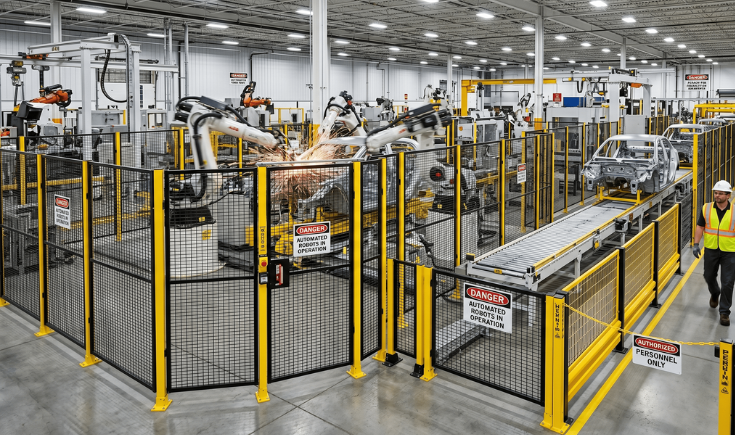
Safety fencing helps protect workers from robotic systems, conveyor lines, welding stations, and automated machinery while improving workplace safety and productivity.
- Get in Touch
- +91 96840 33261
- Location
- Pune Maharashtra India
- Mail Us
- sales1@swizasafetech.in
Best Safety Fencing Solutions for Automotive Manufacturing Plants
- Swiza Safetech
- May 20, 2026
Introduction
Automotive manufacturing plants are among the most advanced industrial environments where automation, robotics, conveyor systems, welding stations, and heavy machinery operate continuously. While these technologies improve production efficiency and precision, they also create significant workplace safety challenges. To maintain safe and productive industrial operations, automotive manufacturers rely heavily on industrial safety fencing systems and machine guarding solutions that protect workers, equipment, and automated processes.
Modern safety fencing solutions play a critical role in reducing workplace accidents, improving factory organization, and ensuring compliance with industrial safety standards. As automation and Industry 4.0 technologies continue transforming the automotive sector, industrial safety fencing will remain a vital component of smart and secure manufacturing environments.
Importance of Safety Fencing in Automotive Manufacturing Plants
Automotive factories involve high-speed robotic systems, automated assembly lines, laser cutting machines, and material handling equipment that require proper isolation from workers and unauthorized access. Industrial safety fencing acts as a protective barrier that separates hazardous operational zones from employee workspaces while maintaining smooth production flow.
In automotive manufacturing facilities, machine safety fencing helps reduce the risk of injuries caused by robotic movement, moving machine parts, sparks, welding operations, and automated conveyor systems. Safety fencing solutions also improve workplace discipline by clearly defining restricted areas and safe walking paths.
Machine Guarding Solutions for Robotic Assembly Lines
Robotic automation has become essential in automotive manufacturing because of its speed, consistency, and precision. However, robotic systems operate with powerful and fast-moving mechanical components that can create serious safety risks if workers accidentally enter operational zones.
Industrial
robotic fencing systems
are commonly installed around robotic welding cells, automated assembly stations, and material transfer systems. These machine guarding solutions create secure operational zones while allowing controlled access through interlocked safety doors and sensor-based entry systems.
Benefits of robotic machine guarding include:
- 1. Improved worker protection from automated equipment
- 2. Reduced risk of workplace injuries and accidents
- 3. Better operational monitoring and visibility
- 4. Compliance with industrial safety regulations
- 5. Controlled access to hazardous areas
Benefits of Modular Safety Fencing Systems
Modular safety fencing has become one of the most preferred industrial safety solutions for automotive manufacturing plants because of its flexibility, durability, and ease of installation. Unlike traditional welded barriers, modular fencing systems can be customized according to production line layouts and future factory expansion requirements.
Automotive manufacturers frequently update assembly lines to support new vehicle models and production technologies. Modular fencing systems allow industries to reconfigure safety barriers without major structural changes, making them highly cost-effective in dynamic manufacturing environments.
Key advantages of
modular safety fencing
include:
- 1. Easy installation and reconfiguration
- 2. Long-term durability in industrial environments
- 3. Enhanced machine visibility and airflow
- 4. Lower maintenance requirements
- 5. Improved access for equipment servicing
Safety Fencing for Automated Conveyor Systems
Conveyor systems are widely used in automotive manufacturing plants to transport engines, body panels, vehicle components, and finished products across assembly lines. Since
conveyor systems
operate continuously at high speeds, they present significant safety risks in industrial facilities.Safety fencing around conveyor systems helps prevent worker contact with moving machinery and reduces risks associated with entanglement, falling materials, and mechanical injuries. Conveyor guarding systems also improve traffic management by separating pedestrian pathways from automated operational zones.
Many automotive plants prefer wire mesh safety fencing because it provides excellent visibility while maintaining strong physical protection around conveyor lines and material handling systems.
Industrial Safety Barriers for Welding and Fabrication Areas
Welding and fabrication operations are essential parts of automotive manufacturing processes. These operations involve exposure to sparks, smoke, intense heat, and hazardous radiation, making proper safety barriers necessary for worker protection.
Industrial safety fencing and welding barriers help isolate hazardous work areas and reduce worker exposure to dangerous conditions. Heat-resistant safety fencing systems, welding curtains, and machine guarding panels are widely used to create safer fabrication environments within automotive plants.
Compliance with Industrial Safety Standards
Automotive manufacturers are required to follow strict workplace safety regulations to protect employees and maintain operational compliance. Industrial safety fencing systems help companies meet OSHA safety standards, ISO compliance requirements, and internal factory safety protocols.
Compliance-focused machine guarding systems provide better risk management while helping automotive manufacturers avoid production downtime, workplace incidents, and legal penalties caused by safety violations.
Future of Safety Fencing in Automotive Manufacturing
The future of industrial safety fencing is closely connected with Industry 4.0 technologies and smart manufacturing systems. Modern automotive plants are increasingly adopting intelligent machine guarding solutions integrated with sensors, automated locking systems, and real-time safety monitoring technologies.
Smart safety fencing systems can detect worker movement, monitor restricted zones, and automatically stop machinery during unsafe situations. These advanced industrial safety solutions improve workplace safety while supporting higher operational efficiency and automation reliability.
Conclusion
Safety fencing solutions are essential for maintaining safe, efficient, and compliant operations in automotive manufacturing plants. From robotic assembly lines and conveyor systems to welding stations and automated production zones, industrial safety fencing plays a major role in protecting workers and equipment while supporting uninterrupted manufacturing operations.
Modern automotive industries require advanced
machine guarding systems
that provide durability, flexibility, visibility, and smart safety integration. By investing in high-quality industrial safety fencing solutions, automotive manufacturers can improve workplace safety, reduce operational risks, increase productivity, and support long-term industrial growth.
FAQs
-
Why is safety fencing important in automotive manufacturing plants?
-
What type of safety fencing is commonly used in automotive industries?Automotive industries commonly use modular safety fencing, wire mesh barriers, robotic cell fencing, and machine guarding systems.
-
How does machine guarding improve factory safety?Machine guarding systems prevent unauthorized access to hazardous machinery, reduce workplace accidents, and improve operational safety.
-
Are modular safety fencing systems suitable for automated production lines?Yes, modular safety fencing systems are flexible, durable, and can be easily modified to match changing production line requirements.
-
Can industrial safety fencing help with OSHA and ISO compliance?Yes, industrial safety fencing solutions help automotive manufacturers comply with OSHA and ISO workplace safety standards.
-
What are the benefits of robotic fencing systems?Robotic fencing systems improve worker safety, control machine access, and help maintain secure automated manufacturing operations.
