- Get in Touch
- +91 96840 33261
- Location
- Pune Maharashtra India
- Mail Us
- sales1@swizasafetech.in
Conveyor Nip Point Guarding: Where to Guard Belt and Roller Conveyors
- Swiza Safetech
Where conveyor nip point guarding is needed
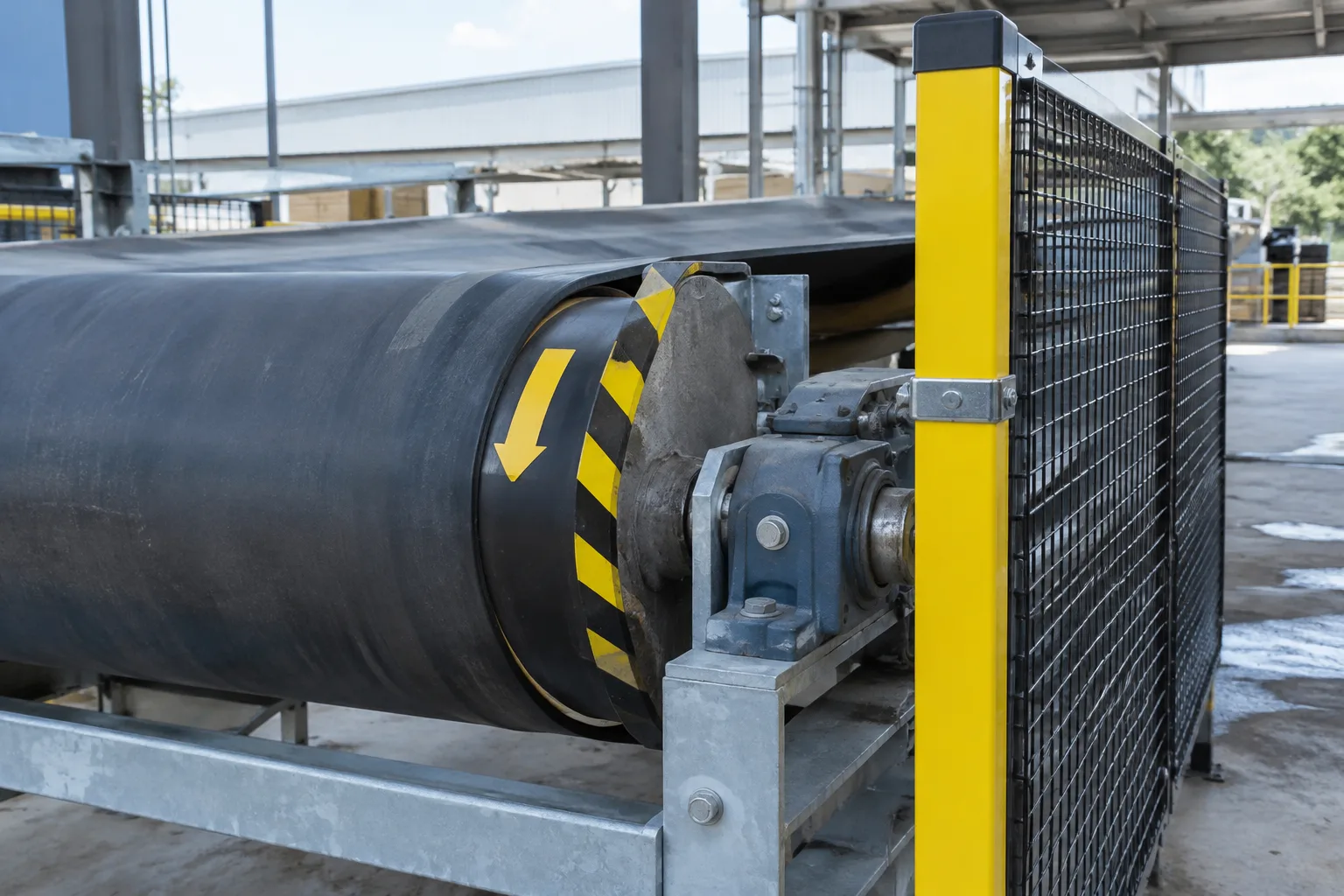
Conveyor nip point guarding is needed wherever a moving belt, chain or roller meets a pulley, sprocket, idler or fixed part of the frame in a way that can draw in a hand, sleeve or glove. On belt conveyors, the highest-risk locations are the head, tail, drive, snub and take-up pulleys, followed by return idlers and transfer points. On roller conveyors, the drive chains, belt-driven rollers and the gaps at transfers and merges need the most attention.
Entanglement injuries on conveyors rarely happen to someone standing at a distance during normal running. They tend to happen during cleaning, belt tracking, clearing a jam or reaching in to straighten a product. That makes guarding a mapping exercise first: you need to know exactly where each in-running point sits, how a person might reach it, and how often someone works nearby. This post walks through those locations on belt and roller conveyors and explains how each is typically guarded.
Nip points, pinch points and shear points: the difference
These terms are often used interchangeably on the shop floor, but separating them helps when you plan the guarding layout.
- Nip point (in-running nip): where two parts rotate towards each other, or where a belt or chain runs onto a pulley, roller or sprocket. Anything caught is pulled inwards. This is the classic conveyor entanglement hazard.
- Pinch point: where a moving part closes towards a fixed part, or a moving load closes against a structure, for example a carton pushed against a side rail or a pallet running into a stop.
- Shear point: where a moving edge passes close to a fixed edge, such as a diverter arm sweeping past a frame member or a pusher retracting past a guide.
In India, Section 21 of the Factories Act, 1948 requires dangerous parts of machinery to be securely fenced, and conveyors fall squarely within that expectation. The Act sets the obligation; your risk assessment determines which points on your particular conveyor are dangerous and how they should be guarded.
Nip points on belt conveyors
Walk the conveyor from tail to head and mark each of the following. On the longer belt conveyors found in automotive and component plants around Chakan and Ranjangaon, a single line can carry dozens of these points.
- Tail pulley: the belt runs onto the pulley at the loading end, often close to where operators place product, which makes it one of the most frequently reached nips.
- Head and drive pulleys: the in-running side of the belt onto the drive pulley, plus the motor, gearbox coupling and any chain or V-belt drive.
- Snub and bend pulleys: these increase belt wrap and create additional in-running nips, often at a height a person can reach from the floor or a walkway.
- Take-up pulleys: gravity and screw take-ups create nips, and a gravity take-up adds a moving counterweight that is itself a crushing hazard.
- Carrying and return idlers: the belt contact point on idlers can draw in fingers, particularly where the belt is loaded or under tension. Return idlers sit low and are easy to reach during cleaning.
- Belt cleaners and scrapers: maintenance staff often reach here to clear build-up, so the guard and access arrangement should remove any reason to do this while the belt is moving.
Pinch and drive points on roller conveyors
Roller conveyors look less threatening than belt conveyors, but powered roller systems carry their own entanglement risks.
- Chain-driven live roller: sprockets and roller-to-roller chains along the side of the frame form continuous nips and need side covers or full enclosure.
- Belt-driven and line-shaft rollers: drive belts or bands running onto rollers or spools create nips underneath the carrying surface, where they are easy to overlook.
- Gaps between rollers: where powered rollers leave gaps large enough for fingers, or where a pressure roller pushes up against the carrying rollers.
- Accumulation zones: product stopping and starting creates pinch points between loads and against side guides.
Gravity roller conveyors have fewer nip hazards, but pinch points still exist where loads run into stops, end gates or the next conveyor.
Transfer zones, merges and conveyor ends
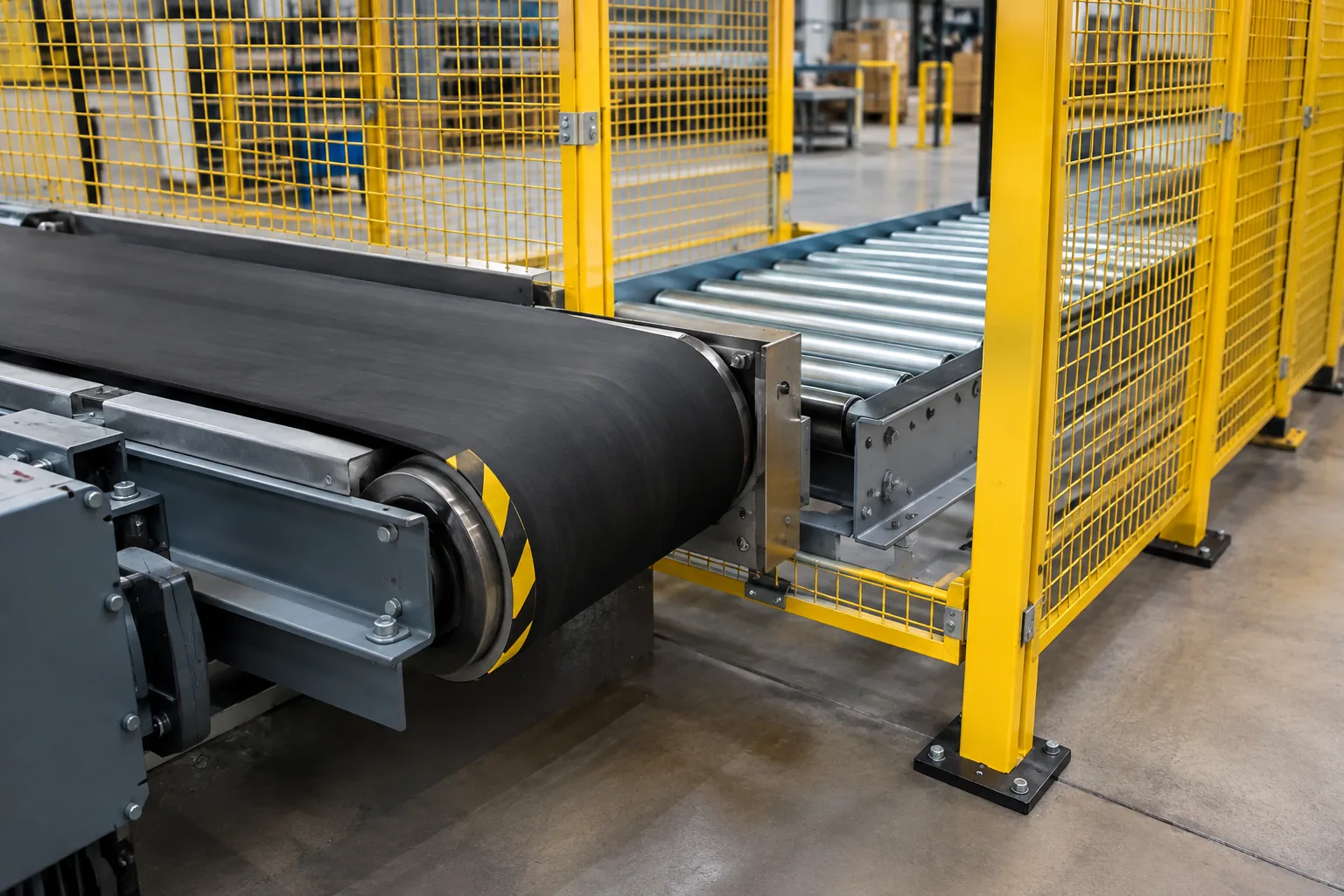
Transfer zones are where most guarding layouts become difficult, because product, people and machinery meet. Typical examples include belt-to-belt and belt-to-roller transfers, 90-degree chain transfers, turntables, lift tables, merges and diverters, and the infeed to a palletizer or packaging machine.
At these points the hazards combine: in-running nips at the conveyor ends, pinch points between moving loads, and shear points at diverter mechanisms. Local covers alone are often impractical because the product must pass through. A common approach is to enclose the whole transfer zone with perimeter conveyor guarding that prevents access to hazardous moving parts, with openings sized only for the product path and access doors where maintenance is needed.
Choosing the guard: fixed, movable or perimeter fencing
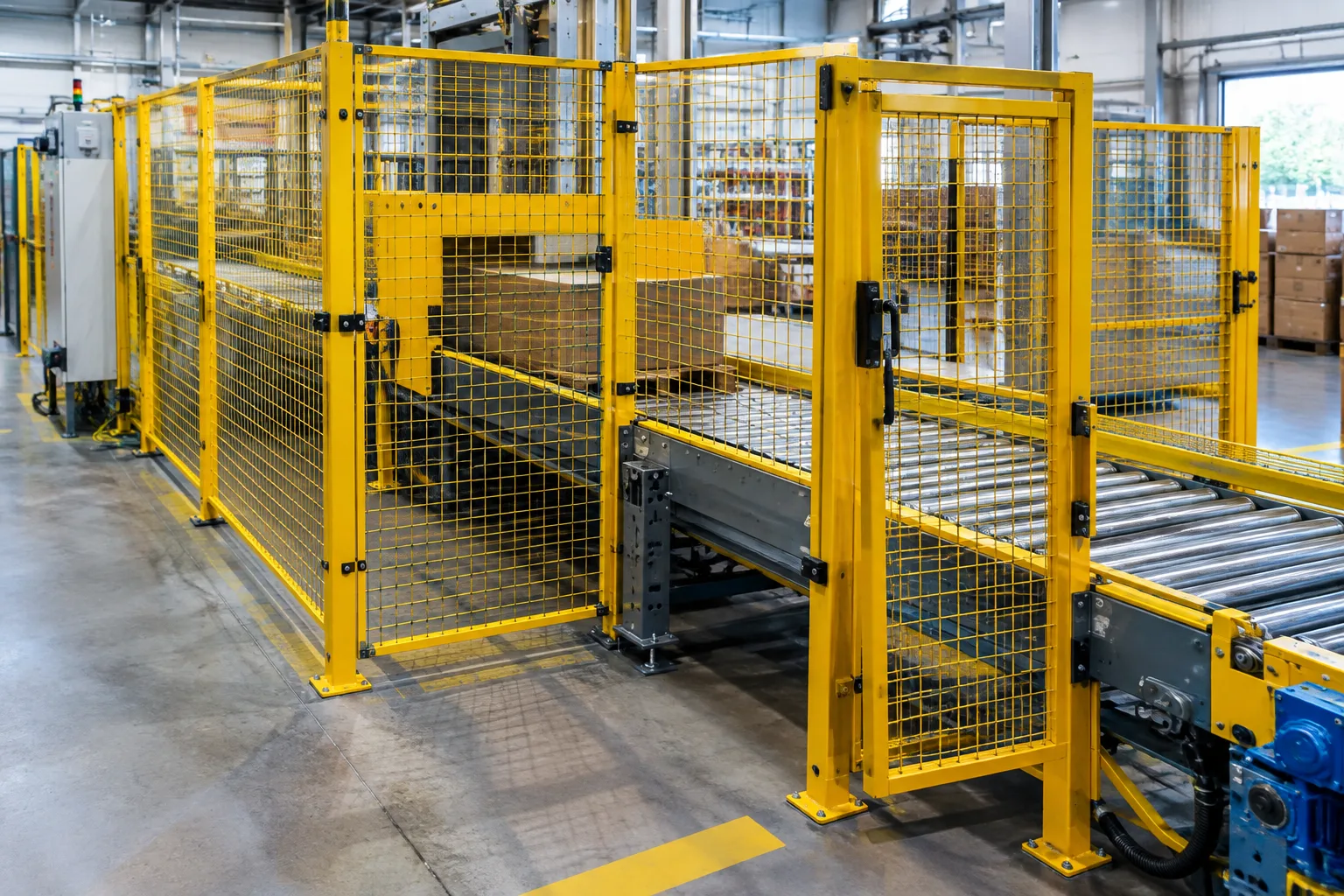
Once every point is mapped, the guard type follows largely from how often access is needed.
- Fixed guards close to the hazard: covers over pulleys, drive chains and couplings, used where access is rarely needed and fastened so that tools are required to remove them.
- Movable guards with interlocks: used where operators or maintenance staff need frequent access, such as at a jam-prone transfer. The interlock should be tied into the conveyor control so hazardous motion stops before the hazard can be reached.
- Perimeter conveyor safety fencing: used where a conveyor section has many hazards close together, or where it runs into robotic cells, palletizers or automated lines. Fencing creates a defined zone, and entry is controlled with doors and locks.
ISO 14120:2015 sets general requirements for the design and construction of fixed and movable guards, covering aspects such as fixing, strength and visibility. Openings in any guard or fence must also be checked against ISO 13857, which relates the size of an opening to how far a person can reach through it. In practice, a smaller mesh opening allows the fence to sit closer to a nip, while a larger opening requires more distance.
Swiza Safetech manufactures conveyor safety fencing from modular steel mesh safety panels on the 40x40 column series or 40x60 column series, with single-hinge, double-hinge and folding doors, locks and connectors. Our published specifications list a 20x100x3 mm mesh panel for the applicable product, and our product literature describes ARAI impact testing of specified 40x40 and 40x60 fencing configurations (ARAI inspection reference FMCE/3100015707(22-23)/SS/548(22-23)). Panel sizes, heights and powder-coated finishes are configured to the layout. The suitability of any guard must still be assessed against the conveyor's hazards and the complete safety design.
Keeping access for maintenance without defeating the guard
Guards that make routine work difficult tend to be removed or propped open. Good conveyor nip point guarding plans for the tasks that happen most often:
- Place access doors at belt tracking adjustment points, take-ups and cleaners rather than relying on panels that must be unbolted.
- Use mesh that allows belt tracking and product flow to be checked without opening the guard.
- Bring lubrication and inspection points outside the guarded zone where the conveyor design allows.
- Combine guarding with isolation and lockout procedures for any task that requires entry into the hazard zone.
For more on how well-planned guarding supports throughput as well as safety, read about the benefits of conveyor guarding for safety and efficiency. For layouts covering wider loading and dispatch areas, see our article on conveyor fencing for safer material handling areas.
What to share for a conveyor guarding quotation
For material handling conveyor guarding in Pune, Pimpri-Chinchwad, Talegaon and across Maharashtra, our team at Bhosari MIDC can prepare a project-specific guarding layout when we receive:
- A conveyor layout drawing or plan, with lengths, heights and transfer points marked.
- Locations of drives, pulleys, take-ups and any existing guards.
- Product dimensions and the openings needed for product flow.
- Access needs for operators and maintenance, including how often each point is reached.
- Interfaces with robots, palletizers or other machinery, and any interlocking or control requirements.
- Your risk assessment findings, where available.
Share your machine layout, drawings or photographs of the existing conveyor and request a quotation from our technical team. We will work through the guarding layout with you so the fencing fits the conveyor, the process and the people who work around it.
Frequently asked questions
What is a nip point on a conveyor?
A nip point is where a belt, chain or roller runs onto a pulley, sprocket or idler, or where two parts rotate towards each other. Anything caught at that point, such as a glove, sleeve or finger, is drawn inwards. Head, tail, snub and take-up pulleys are the most common nip points on belt conveyors.
Should conveyor nip points be guarded with covers or with fencing?
It depends on how often access is needed and how many hazards sit close together. Isolated pulleys and drives are often fitted with fixed covers, while transfer zones, palletizer infeeds and sections with many hazards are usually better enclosed with perimeter fencing and access doors. The choice should come from a risk assessment of the specific conveyor.
Can guarding be added to an existing conveyor?
Yes. Modular mesh fencing with 40x40 or 40x60 columns can be configured around existing conveyors, drives and transfer points. Share a layout or photographs of the conveyor so the panel sizes, openings and door positions can be planned to suit the installation.
Which standards apply to conveyor guards?
ISO 14120:2015 gives general requirements for the design and construction of fixed and movable guards, and ISO 13857 relates opening sizes to safe reach distances. In India, Section 21 of the Factories Act, 1948 requires dangerous parts of machinery to be securely fenced. The specific requirements for your conveyor should be confirmed through risk assessment.
When do conveyor guard doors need interlocks?
Interlocked access doors are generally considered where operators or maintenance staff need frequent access to a hazard zone, such as for clearing jams at transfers. The interlock should connect to the conveyor control so hazardous motion stops before a person can reach the hazard. The control system design should be reviewed by a competent safety engineer.
