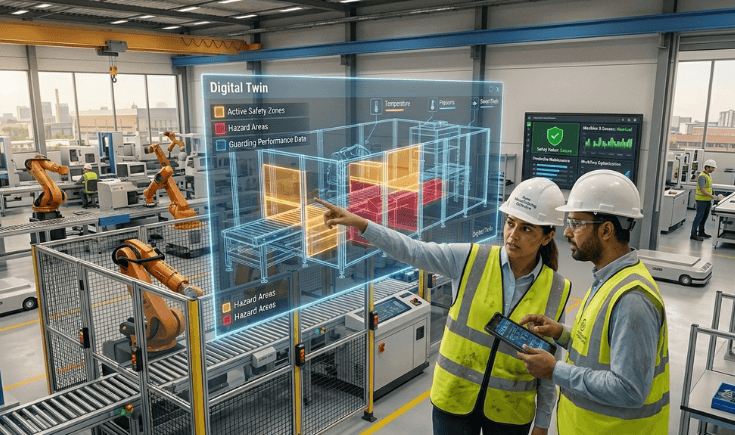
It helps identify potential risks, simulate hazardous situations, and implement preventive safety measures, reducing workplace accidents and improving safety compliance.
- Get in Touch
- +91 96840 33261
- Location
- Pune Maharashtra India
- Mail Us
- sales1@swizasafetech.in
Digital Twin Technology in Manufacturing for Industrial Safety Planning in India
- Swiza Safetech
- March 16, 2026
Digital Twin Technology is rapidly transforming the manufacturing industry in India by enabling companies to create virtual replicas of machines, systems, and entire production lines. This innovative approach helps manufacturers improve operational efficiency while strengthening industrial safety planning. With the rise of smart factories, automation, and Industry 4.0, digital twin solutions are becoming essential for identifying risks, optimizing workflows, and ensuring safer working environments. In growing industrial hubs like Pune, businesses are increasingly adopting digital twin technology to enhance productivity and meet evolving safety standards.
Introduction to Digital Twin Technology in Manufacturing Industry
Digital Twin Technology refers to a digital representation of physical assets, processes, or systems used in manufacturing. These virtual models are continuously updated using real-time data collected from sensors, machines, and connected devices. In the manufacturing industry, this technology allows companies to monitor operations, simulate production scenarios, and improve decision-making. By creating a real-time digital environment, manufacturers can identify inefficiencies, reduce downtime, and enhance safety planning. As industries across India modernize, digital twins are playing a key role in building smarter, safer, and more efficient manufacturing systems.
What is Digital Twin Technology in Manufacturing and How It Works with IoT
Digital Twin Technology works by integrating physical machines with digital systems through IoT (Internet of Things). Sensors installed on machines collect real-time data such as temperature, pressure, speed, and performance metrics. This data is then transmitted to a digital platform where a virtual model replicates the behavior of the physical system. Engineers and operators can analyze this model to simulate different scenarios, test changes, and predict outcomes. In manufacturing safety, this helps identify potential hazards such as machine failures, unsafe operations, or system inefficiencies. By using IoT-enabled digital twins, companies can move from reactive maintenance to predictive and preventive strategies.
Importance of Digital Twin Technology for Industrial Safety Planning in India
Industrial safety has become a top priority for manufacturing companies in India. Traditional safety methods often rely on manual inspections and past incident data, which may not always prevent future risks. Digital Twin Technology offers a proactive approach by enabling real-time monitoring and simulation of manufacturing processes. It allows companies to identify unsafe conditions early, test safety measures virtually, and implement improvements without disrupting operations. This is particularly important in industrial regions like Pune, where high production demand and advanced machinery require strong safety systems. Digital twins help businesses comply with safety regulations, reduce workplace accidents, and create a safer environment for employees.
Key Benefits of Digital Twin Technology in Manufacturing Safety and Risk Management
One of the biggest advantages of Digital Twin Technology is its ability to predict risks before they occur. By simulating real-world scenarios, manufacturers can identify potential hazards and take preventive action. Another key benefit is improved decision-making. With access to real-time data and insights, managers can optimize production layouts, workflows, and safety measures. Digital twins also support predictive maintenance, allowing companies to detect equipment issues early and avoid unexpected failures. This reduces downtime and improves operational efficiency. Additionally, the technology helps in cost reduction by minimizing accidents, equipment damage, and production delays, making it a valuable investment for modern manufacturing businesses.
Top Applications of Digital Twin in Industrial Safety and Smart Manufacturing
Digital Twin Technology is widely used in various industrial safety and manufacturing applications. One major application is in machine guarding system design, where companies can test safety barriers and protective systems before implementation. It is also used in robotic automation to simulate machine movements and avoid collisions, ensuring safe human-machine interaction. In automated production lines, digital twins help monitor equipment performance in real time and detect abnormalities early. Another important application is virtual training, where employees can learn safety procedures in a simulated environment without exposure to real risks. This improves safety awareness and reduces the chances of workplace accidents.
Role of Digital Twin in Machine Guarding Systems and Safety Fencing Solutions
Machine guarding and safety fencing are critical components of industrial safety. Digital Twin Technology enhances these systems by allowing manufacturers to design and test them in a virtual environment. By creating a digital model of the factory layout, companies can analyze different configurations of safety guards, fencing systems, and interlocking mechanisms. This ensures maximum protection while maintaining productivity. Digital twins also help evaluate the performance of safety systems during emergency scenarios, ensuring that all protective measures function effectively. This makes them highly valuable for designing reliable industrial safety solutions.
Conclusion: Why Digital Twin Technology is Essential for Manufacturing Safety in India
Digital Twin Technology is revolutionizing manufacturing safety by shifting from reactive approaches to predictive and preventive strategies. It enables companies to identify risks, optimize safety systems, and create safer working environments. As industrial safety standards continue to evolve in India, adopting digital twin solutions is becoming essential for long-term growth. Businesses that invest in this technology will benefit from improved safety, higher productivity, and better operational efficiency.
FAQs
-
How does Digital Twin improve industrial safety in India?
-
What are the benefits of Digital Twin Technology in manufacturing?The main benefits include predictive maintenance, improved safety planning, real-time monitoring, reduced downtime, cost savings, and better decision-making.
-
How is Digital Twin Technology used in smart factories?In smart factories, digital twins are used to simulate production processes, monitor equipment, enhance automation safety, and optimize overall operations.
-
Why is Digital Twin important for Industry 4.0 in India?Digital Twin Technology supports automation, data exchange, and smart manufacturing systems, making it a core component of Industry 4.0 in India.
-
Is Digital Twin Technology used by manufacturing companies in Pune?Yes, many manufacturing companies in Pune are adopting digital twin solutions to improve safety, optimize processes, and stay competitive in modern industrial environments.
