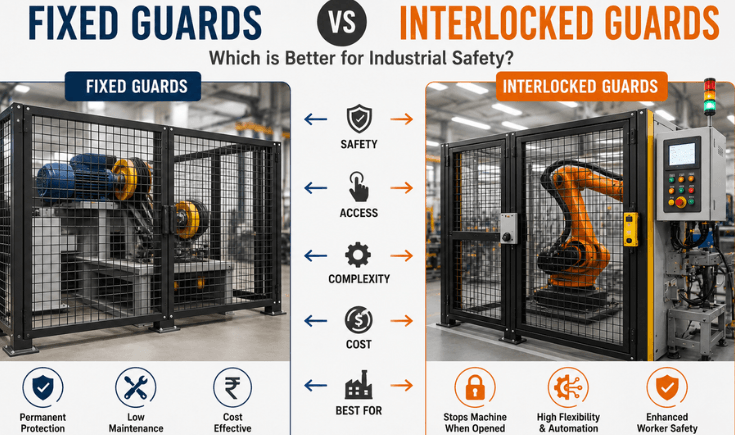
Fixed guards are permanently attached safety barriers, while interlocked guards automatically stop machine operation when opened or removed.
- Get in Touch
- +91 96840 33261
- Location
- Pune Maharashtra India
- Mail Us
- sales1@swizasafetech.in
Fixed Guards vs Interlocked Guards: Which is Better for Industrial Safety?
- Swiza Safetech
- May 15, 2026
Introduction
Industrial workplaces operate with high-speed machinery, robotic systems, conveyor lines, and automated production equipment that can pose serious risks if proper safety measures are not implemented. Machine guarding plays a critical role in preventing workplace injuries, reducing downtime, and ensuring compliance with international safety standards. Among the most commonly used machine guarding solutions are
fixed guards
and interlocked guards. While both are designed to protect workers from hazardous machine components, their functionality, application, and level of protection differ significantly. Understanding the difference between fixed guards and interlocked guards is essential for manufacturers, warehouse operators, and industrial plant managers looking to improve workplace safety and operational efficiency. Choosing the right guarding system depends on the type of machinery, production environment, accessibility requirements, and regulatory compliance standards.
What Are Fixed Guards in Industrial Machine Safety?
Fixed guards are permanent physical barriers attached directly to machinery to prevent workers from accessing dangerous moving parts during machine operation. These guards are typically installed using bolts, screws, or welding methods and can only be removed with tools. Fixed guards are widely used in manufacturing facilities because they provide reliable and continuous protection without depending on electrical or sensor-based systems. Industries commonly install fixed guards around rotating shafts, cutting blades, conveyor systems, gears, pulleys, and mechanical transmission equipment. Their simple design makes them highly durable and cost-effective for long-term industrial applications. Since fixed guards do not require sensors or control systems, they are easier to maintain and less prone to technical failures.
What Are Interlocked Guards?
Interlocked guards are advanced machine safety systems designed to stop machine operation automatically whenever a guard is opened, removed, or improperly positioned. These guarding systems are connected to electrical or electronic safety controls that immediately shut down hazardous machine movement when access points are activated.
Interlocked guards are widely used in robotic cells, CNC machinery, automated production lines, packaging systems, and industrial automation environments where operators frequently require access for cleaning, maintenance, adjustments, or material loading.
Key Differences Between Fixed Guards and Interlocked Guards
The primary difference between fixed guards and
interlocked guards
lies in accessibility and machine interaction. Fixed guards remain permanently attached during machine operation and require tools for removal, making them ideal for machines that do not need frequent operator access. In contrast, interlocked guards are designed for machinery requiring regular human interaction because they automatically stop hazardous machine movement whenever access points are opened. Fixed guards are generally more affordable, easier to install, and require less maintenance compared to interlocked systems. However, they may reduce operational convenience in environments where frequent machine access is necessary. Interlocked guards offer superior flexibility and enhanced protection but involve more complex installation and higher initial investment due to integrated safety electronics and control systems. Manufacturers often select fixed guards for low-maintenance mechanical equipment, while interlocked guards are preferred for automated machinery and high-risk industrial processes where worker interaction is unavoidable.
Advantages of Fixed Guards
Fixed guards remain one of the most widely used
machine safety solutions
because of their simplicity, durability, and affordability. Since they do not rely on electrical components or sensors, they provide reliable protection with minimal technical failure risk.
Industrial environments exposed to dust, vibration, moisture, or high temperatures often benefit from fixed guards because of their robust construction and low maintenance requirements. Small and medium-sized manufacturing units frequently prefer fixed guards because they offer cost-effective industrial safety protection without increasing operational complexity.
Advantages of Interlocked Guards
Interlocked guards provide a higher level of protection in modern automated manufacturing facilities where operator access is necessary. Their ability to stop machine movement automatically helps reduce serious workplace injury risks during maintenance, troubleshooting, or production adjustments.
One of the biggest advantages of interlocked guards is operational efficiency. Workers can safely access machinery without completely removing protective barriers, helping reduce downtime and improve workflow productivity. Advanced interlocking systems also integrate with Industry 4.0 automation technologies and intelligent safety monitoring systems.
Which Machine Guarding System Is Better?
There is no single answer to whether fixed guards or interlocked guards are better because the ideal machine guarding solution depends entirely on industrial application requirements. Fixed guards are highly effective for machines that require minimal operator interaction and where durable, low-maintenance protection is preferred.
Interlocked guards are better suited for automated machinery and industrial processes where operators require regular machine access. Many manufacturing facilities combine fixed guards and interlocked guards to create layered safety systems that maximize worker protection while maintaining production flexibility.
Conclusion
Fixed guards and interlocked guards both play an essential role in
industrial machine safety systems
.Fixed guards offer durable, cost-effective protection for machinery with limited operator interaction, while interlocked guards provide advanced safety control for automated production environments requiring regular access.
Choosing the right machine guarding system depends on machinery type, operational workflow, maintenance requirements, and compliance standards. Industries that invest in properly designed machine guarding solutions improve workplace safety, increase productivity, and strengthen long-term operational performance.
FAQs
-
What is the difference between fixed guards and interlocked guards?
-
Where are interlocked guards commonly used?Interlocked guards are commonly used in robotic cells, CNC machines, automated assembly lines, and packaging systems.
-
Are fixed guards OSHA compliant?Yes, properly designed fixed guards help industries comply with OSHA machine guarding safety standards.
-
Which machine guarding system is more cost-effective?Fixed guards are generally more affordable and require lower maintenance compared to interlocked guarding systems.
-
Can industries use both fixed guards and interlocked guards together?Yes, many industrial facilities combine both guarding systems to create comprehensive workplace safety solutions.
