- Get in Touch
- +91 96840 33261
- Location
- Pune Maharashtra India
- Mail Us
- sales1@swizasafetech.in
Machine Guarding RFQ Checklist: What to Send a Pune Fencing Manufacturer for an Accurate Quote
- Swiza Safetech
A useful machine guarding RFQ checklist covers four things: a dimensioned layout drawing, machine and hazard data, access requirements and site conditions. When a fencing manufacturer receives all four, it can calculate panel counts, column positions, door types and installation effort, and return a firm quotation instead of a rough estimate. The choices that move the price most are total run length and height, column series, door and lock specifications, and the number of non-standard panels the layout needs.
Below is what our technical team at Swiza Safetech in Bhosari MIDC, Pune, looks for when a request for quotation arrives, and why each item matters to the final price and lead time.
The machine guarding RFQ checklist at a glance
- Layout drawing in DWG, DXF or PDF, with the fence line marked and key dimensions shown.
- Machine data: machine type, footprint, height, moving parts, reach envelope and hazard zones.
- Access needs: number of doors, door type, clear opening widths and lock or interlock requirements.
- Site conditions: floor type, obstructions, overhead clearances and the available installation window.
- Specification preferences: column series, mesh panel type, finish colour and any customer or OEM standard you must follow.
- Commercial details: quantity, delivery location, required date and whether installation is included.
Layout drawings: the base of an accurate quote
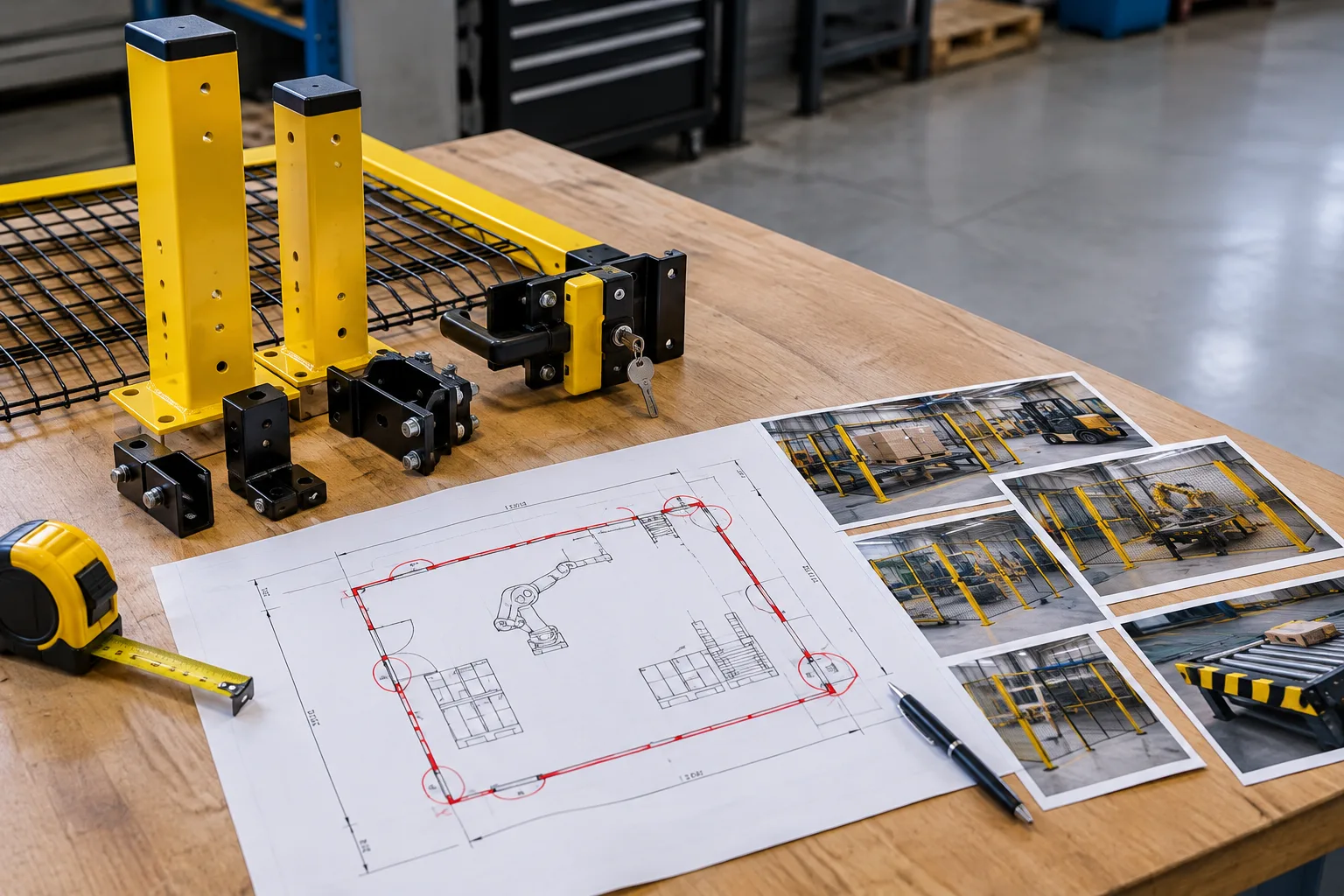
The layout drawing is the single most important document in the RFQ. A plan view showing the machine, the proposed fence line and the door positions lets us break the perimeter into standard panel widths and identify exactly where special panels are needed. Please mark:
- Overall length of each side of the fence line
- Corners and angles, especially anything other than 90 degrees
- Fixed obstructions such as building columns, pillars, cable trays and floor trenches
- Conveyors, cables or pipes that must pass through the fence
- Positions of control panels, HMIs and operator stations outside the guarded area
- Required fence height, if already decided by your risk assessment
If no CAD drawing exists, a hand sketch with tape measurements and photographs from each corner is a workable starting point. For existing machines on a running line, photographs often reveal details a drawing misses, such as utility drops, uneven floor sections or a pallet route that crosses the planned fence line.
Machine data and hazard information
The fence has to suit the machine it guards. Tell us what the machine is (robotic cell, palletizer, conveyor, press, test rig or special-purpose machine), its overall dimensions, its reach envelope or travel, and where the hazards are. For robotic cell safety fencing, the robot's maximum reach and any risk of parts or tooling being ejected strongly influence fence position and height.
Fence height, opening size and distance from the hazard are linked. ISO 13857 sets out safety distances to prevent upper and lower limbs reaching danger zones, relating barrier height and opening size to the distance from the hazard. Mesh aperture matters here: the 20x100x3 mm mesh panel specified in our published literature must be assessed against how far fingers or hands could reach through it at the planned distance. If you have completed a risk assessment, share the relevant findings, because they define what the guarding needs to achieve.
Where impact resistance is a concern, our published product literature describes ARAI impact testing of specified 40x40 and 40x60 fencing configurations, under inspection reference FMCE/3100015707(22-23)/SS/548(22-23). If your application involves ejection hazards, state this clearly in the RFQ so we can discuss whether a tested configuration suits your machine. Test results apply to the configurations tested, not automatically to every layout.
Access needs: doors, interlocks and maintenance routes
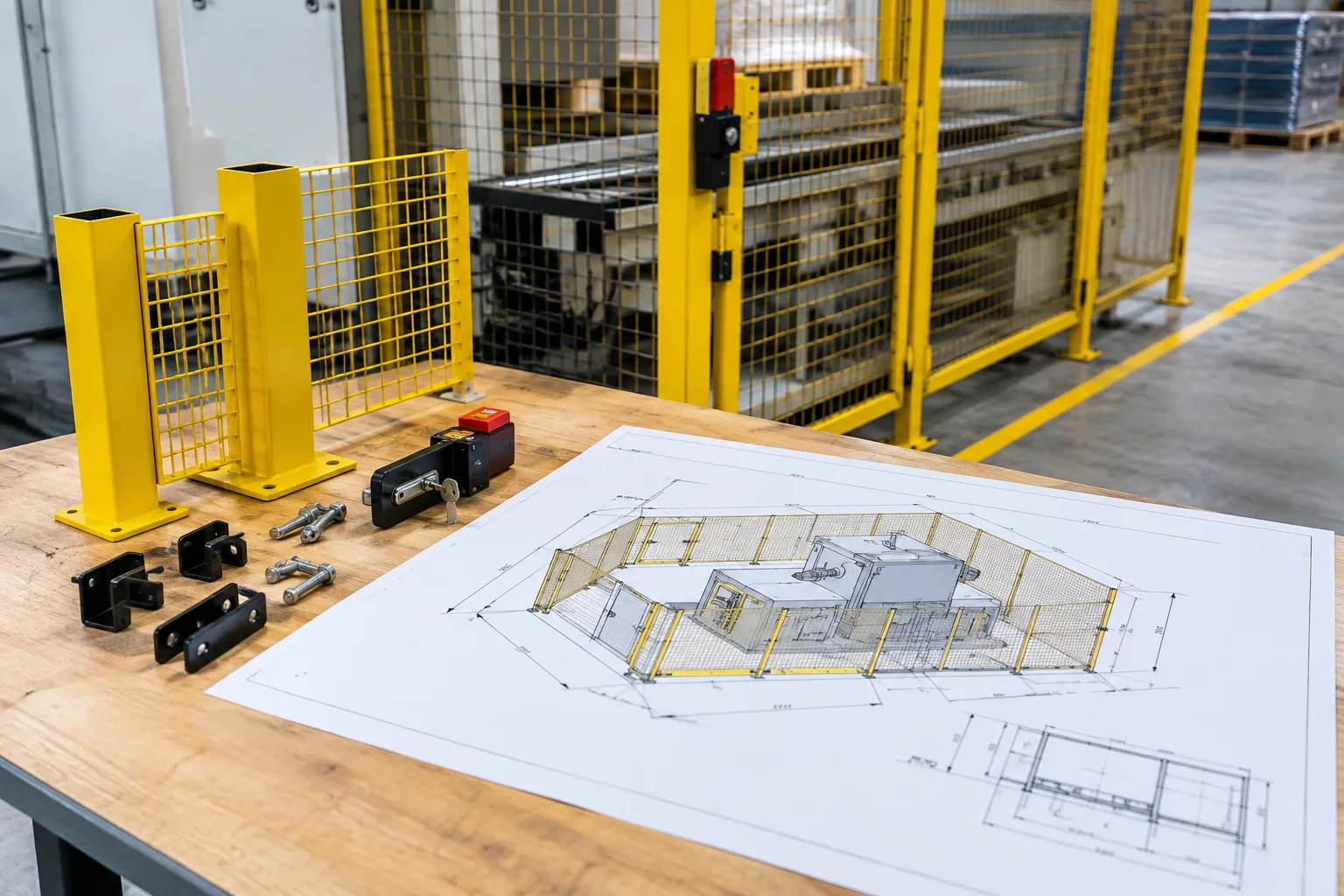
Doors are usually the most variable cost in a fencing package, so describe how people and material will move in and out of the guarded area:
- How often operators, setters or maintenance staff need to enter
- Material loading routes (forklift, pallet truck, trolley) and the clear width each needs
- Preferred door type: single-hinge, double-hinge, folding or sliding
- Whether doors must be interlocked with the machine control, and who supplies the safety switch
- Lock arrangements, including padlock provision for lockout during maintenance
ISO 14120:2015 sets general requirements for the design and construction of fixed and movable guards. Movable guards that give access to hazards generally need interlocking, and the selection of interlocking devices is addressed in ISO 14119. If your integrator is supplying the interlock switch, send its model or mounting details so we can prepare the door frame correctly. Our product brochure shows the doors, locks, connectors and accessories available within the range.
Site conditions and installation
Site details decide how the fence is anchored and how long installation takes. Include:
- Floor type and condition: concrete, epoxy coating, trenches or uneven areas needing levelling
- No-drill zones above underfloor services or foundations
- Overhead clearances, crane runways and ducting
- Access for delivering material to the installation point
- Installation window: planned shutdown, weekend work or installation beside a running line
- Site location, whether Bhosari MIDC, Pimpri-Chinchwad, Chakan, Talegaon, Ranjangaon or Mumbai and Navi Mumbai
Many plants schedule guarding work during a shutdown. Modular construction helps, because panels bolt to columns and can be pre-planned to fit the window, but we need your dates early to align manufacturing and dispatch.
Which choices change the price
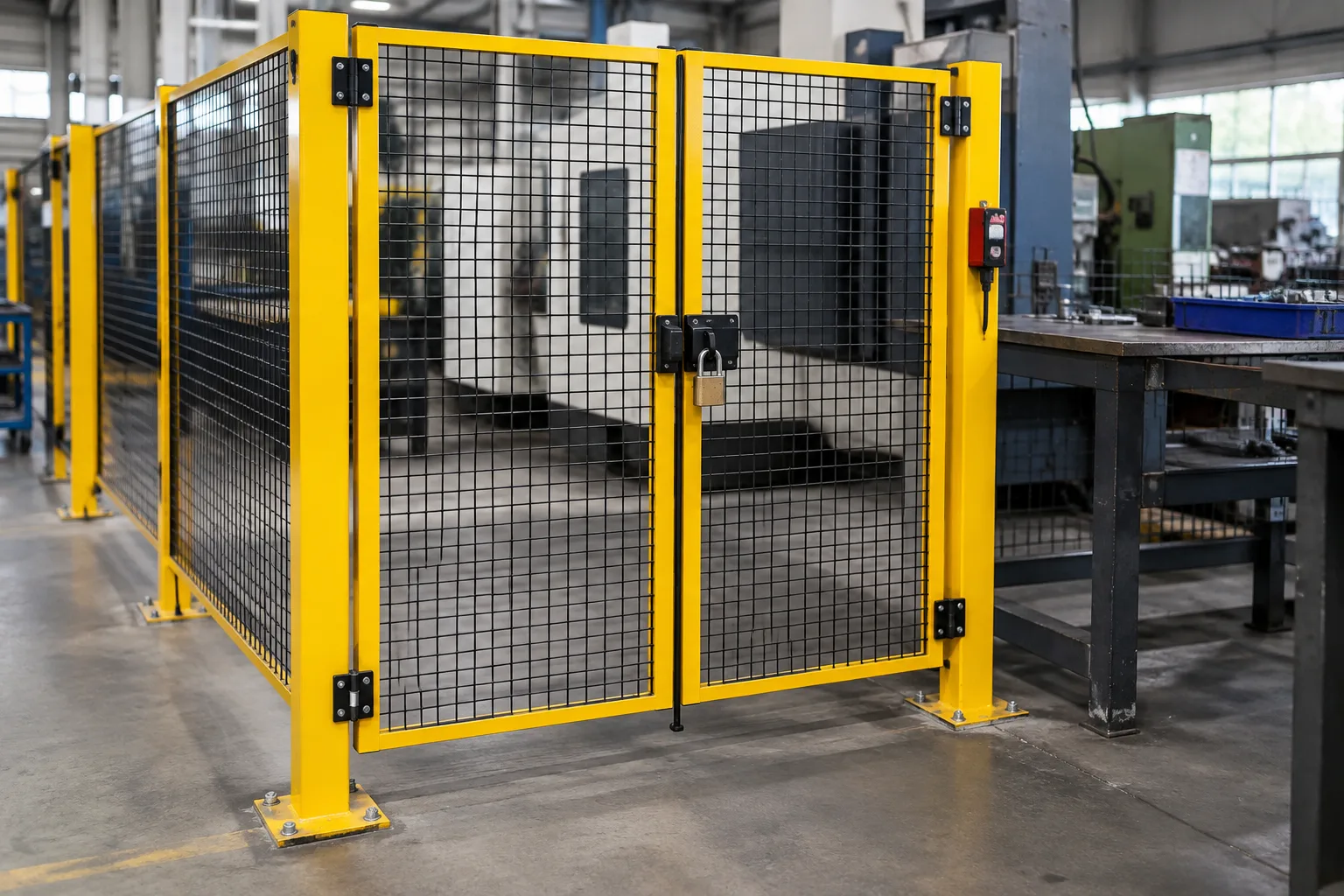
Once the machine guarding RFQ checklist is complete, these are the decisions that most affect your quotation.
Total run length and fence height
More running metres and taller fences mean more panels, more columns and more fixings. Height should come from your risk assessment and safety distance calculation, not from guesswork in either direction.
Column series: 40x40 or 40x60
We manufacture both the 40x40 column series and the 40x60 column series. The heavier 40x60 section is generally considered where greater rigidity is needed, such as taller fences or more demanding applications. It adds material weight and cost, so specify it where the application calls for it.
Standard versus non-standard panels
Our published catalogue lists standard fencing heights and panel widths. Layouts that fit these sizes are the most economical. Special widths, cut-outs for conveyors, cable entry slots and hinged service hatches add fabrication time. If you are weighing flexibility against fit, our article on custom versus modular machine guards explains the trade-offs.
Doors, locks and interlock provisions
Each door adds frames, hinges or tracks and locking hardware. Double-hinge and sliding doors for wide material access cost more than a single personnel door, and interlock mounting adds detailing work.
Finish and colour
Powder-coated panels are available in multiple finish colours. Standard colours are usually quicker and more economical than a specific plant or OEM colour code.
Installation conditions
Night shifts, restricted access, working beside live equipment or difficult anchoring all add time on site and should be stated upfront.
What a quotation does not replace
A fencing quotation covers the physical barrier. The suitability of any guarding system must be assessed against the machine's hazards and the complete safety design, including control system integration, interlock validation, installation quality and ongoing maintenance. We work to your layout and requirements, and the responsibility for risk assessment and overall machine safety remains with the machine builder or user. For an overview of guarding types and how they fit together, see our machine guarding systems page.
Sending your RFQ to a machine guarding manufacturer in Pune
Swiza Safetech manufactures from Bhosari MIDC and supplies plants across Pune, Pimpri-Chinchwad, Chakan, Talegaon, Ranjangaon, Mumbai and the wider Maharashtra region. Our in-house design support can turn your layout into a project-specific fencing plan using steel mesh safety panels, column systems, safety doors and accessories from our industrial safety fencing range.
The more complete your RFQ, the faster and more accurate our response. Share your machine layout, drawings, photographs and access requirements with our technical team and request a quotation.
Frequently asked questions
What is the minimum information needed to get a machine guarding quotation?
At minimum, send a plan sketch or drawing with the fence line and dimensions, the required fence height, the number and type of doors, and the site location. With these, a manufacturer can give a budgetary figure. Machine hazard data and site conditions are needed to firm it up.
Can I send an RFQ without CAD drawings?
Yes. A hand sketch with measured lengths, marked door positions and photographs from each corner of the machine is a workable starting point. The design team can then prepare a fencing layout for your review before the final quotation.
Should I choose 40x40 or 40x60 columns for my machine guarding?
The 40x60 column series is a heavier section generally considered where more rigidity is needed, such as taller fences or more demanding applications. The 40x40 series suits many standard machine guarding layouts. Share your height, layout and hazard details and the technical team can recommend a suitable option.
Does the fencing supplier take responsibility for machine safety compliance?
No. The fencing manufacturer supplies the physical barrier to your specification. Risk assessment, safety distance calculations, interlock integration and overall machine safety validation remain with the machine builder or user.
Can safety fencing be installed during a factory shutdown?
Yes, modular fencing is well suited to shutdown installation because panels bolt to pre-positioned columns. Mention your shutdown dates in the RFQ so manufacturing and dispatch can be planned to fit the window.
