- Get in Touch
- +91 96840 33261
- Location
- Pune Maharashtra India
- Mail Us
- sales1@swizasafetech.in
Machine Safety Fencing Installation During Plant Shutdown: A Diwali Checklist for Pune Plants
- Swiza Safetech
Machine safety fencing installation during plant shutdown goes smoothly when the survey, design and ordering are finished before the line stops. The shutdown days should then be spent only on fixing, wiring and testing. For Pune and Pimpri-Chinchwad plants, the Diwali shutdown is often the one window where robot cells, conveyors and presses are stopped long enough to anchor columns, hang doors and wire interlocks without working next to live equipment.
This checklist follows the sequence we use at Swiza Safetech, from our factory in Bhosari MIDC: site survey, guard gap review, system selection, lead time and installation sequencing.
Why the Diwali shutdown suits machine safety fencing installation
Most fencing work needs the machine stopped. Drilling floor anchors near a robot base, removing an old guard, routing interlock cabling into the control panel and proving the machine will not restart with a door open all mean lockout. During normal production that translates into partial stoppages and contractors working beside running equipment.
A planned shutdown removes that conflict, but the window is fixed. If panels arrive late or a door does not match its opening, the line either restarts with a gap in the guard or restarts late. The planning below is about making sure neither happens.
Step 1: Survey the site while the line is still running
The most useful survey happens on a normal production day, because you see how operators, forklifts and maintenance staff actually move around the machine. Cover these points:
- Measure the guarded footprint, including robot reach envelopes, conveyor transfer points and overhead clearance under cranes, ducting or cable trays.
- Mark floor conditions: expansion joints, trenches, cable ducts and damaged concrete where anchor fasteners will not hold.
- List every reason people enter the area: material loading, tool changes, jam clearing, cleaning and planned maintenance.
- Note where door lock and interlock signals must reach in the machine's control panel.
- Record existing guards that will stay, so new panels can tie into them cleanly.
The requirements vary depending on the machinery configuration. A fence drawn only from a layout drawing often misses a pillar, a hose reel or a forklift aisle, and those surprises are expensive to solve on day two of a shutdown.
Step 2: Find the guard gaps before you order anything
A guard gap is any route by which a hand, arm or whole body can reach a hazard. ISO 14120, the international standard covering the design and construction of fixed and movable guards, requires guards to be designed around the hazard they protect, and it directs designers to ISO 13857 for the safety distances that stop upper and lower limbs reaching danger zones. In practice, the gaps we most often find on plant walk-downs are:
- Clearance under the bottom of the fence that is large enough to reach under.
- Mesh openings or gaps around conveyors that sit too close to a moving part for their size.
- Fence height that is too low for the distance to the hazard behind it.
- Access doors with no interlock, or with one that is easy to defeat.
- Guards removed for maintenance and never refitted.
- Nip points and transfer points left open where a conveyor passes through the fence line.
Write each gap down with a photo and a proposed fix. That list becomes both the purchase scope and the final inspection checklist. Conveyors deserve their own attention, because the fence has to let product through without letting hands in; our conveyor safety fencing page explains how we handle those openings.
Step 3: Lock the design and choose the system
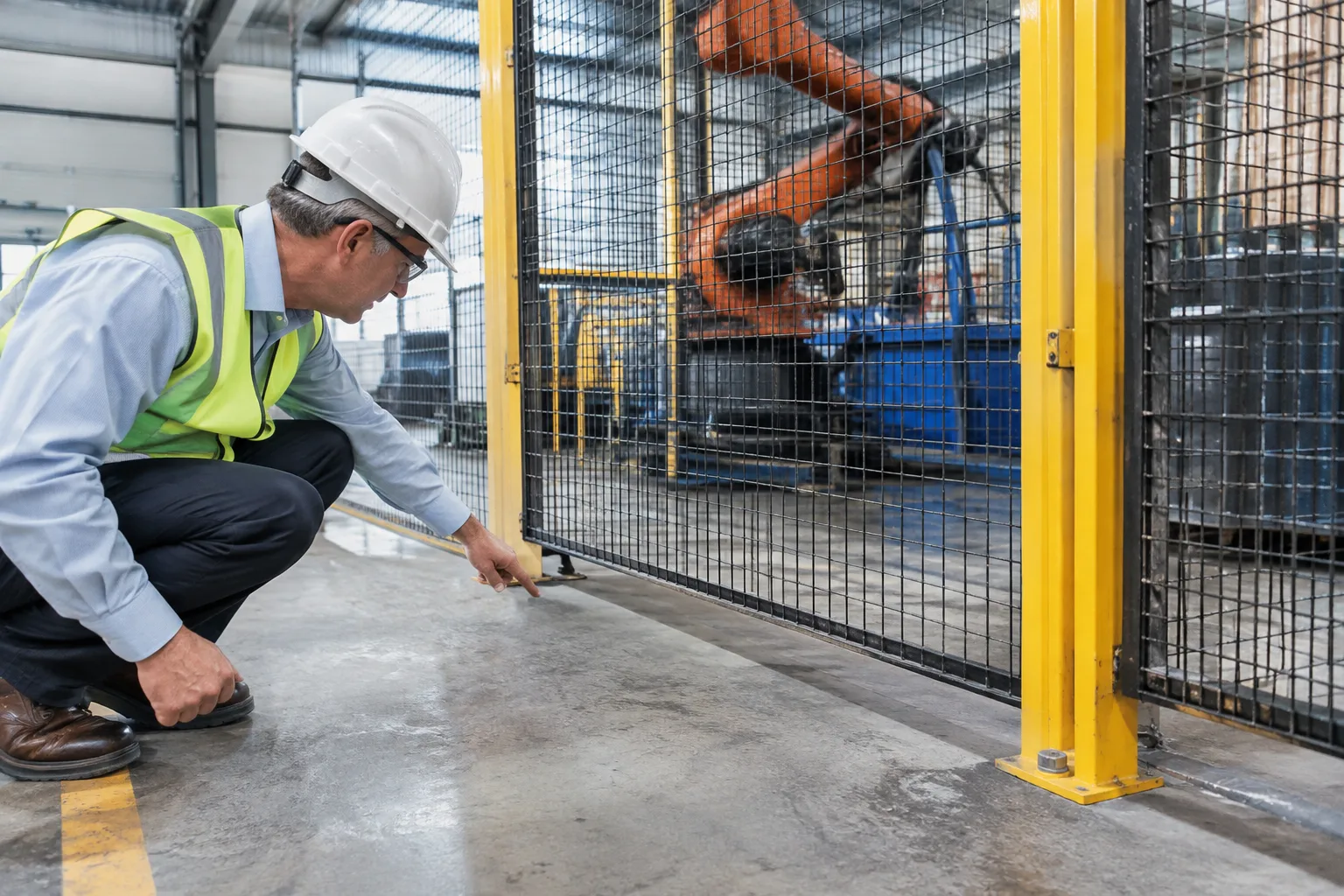
Freeze the design early. Every change made after ordering eats into the calendar you need for manufacturing and delivery.
Column series
Our modular fencing is built on 40x40 and 40x60 column systems. As a general rule the larger 40x60 section is chosen where more rigidity is needed, for example on taller runs or with heavier panels, while 40x40 covers a large share of standard cells. We confirm the series against your layout at the survey stage rather than guessing from a drawing.
Panel infill
Our 20x100 wire mesh panels keep the machine visible and let air through, which suits most robot cells and conveyor lines. Polycarbonate panels are a common choice where coolant, chips or splashes need to be contained while operators still watch the process. Sheet metal panels are used where you need a solid barrier, such as blocking weld spatter or light from a welding cell.
Doors, locks and interlocks
Decide door types now: single-hinge, double-hinge, folding, single-open or double-open, depending on how much clearance is available and what passes through. Then decide which doors need a simple fence door lock, an electric lock or a safety interlock. Interlock wiring needs your controls engineer on site during the shutdown, so book that person at the same time as the fencing crew. Where a machine needs a guard shaped around it, plan custom machine guards as a separate line item, since they take longer than standard modular panels. You can see how these parts combine in our machine guard systems.
Step 4: Build lead time into the calendar
Lead time depends mostly on how much of the job uses stock-ready modular parts and how much is custom-made for your layout. Standard columns, mesh panels and accessories move faster. Custom guards, special doors and panels cut to unusual sizes need more time. Ask your supplier for a confirmed delivery date in writing, then work backwards:
- Site survey and guard gap list.
- Layout drawing issued and approved by your safety and maintenance teams.
- Purchase order released.
- Manufacturing and dispatch.
- Delivery to site before the shutdown begins, not on the first day of it.
- Material staged next to each cell, sorted by area.
Approvals are where schedules usually slip. If drawings sit in an inbox for two weeks, that time comes straight out of manufacturing.
Step 5: Sequence the installation across the shutdown
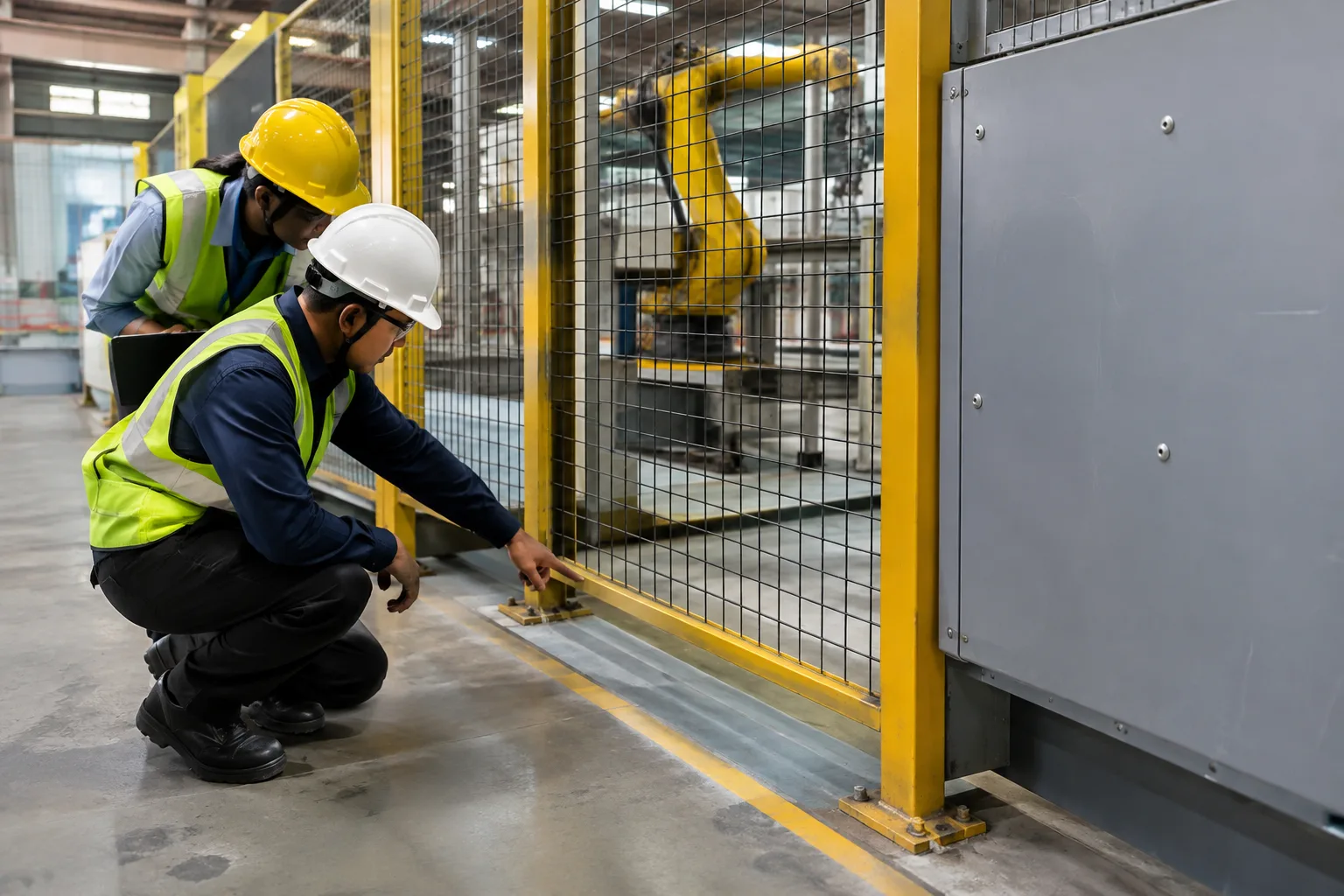
With materials on site, machine safety fencing installation during plant shutdown follows a fixed order:
- Lockout and clear. Isolate machines, remove old guards that are being replaced and clean the floor.
- Mark out and set columns. Snap lines, drill and fit anchor fasteners, and level each column.
- Hang panels. Fit mesh, polycarbonate or sheet metal panels and check bottom clearance and joints.
- Fit doors and hardware. Hinges, locks, caps and castors on any movable sections.
- Wire and test interlocks with your controls team, door by door.
- Walk the perimeter against the guard gap list from Step 2.
- Hand over and restart.
Start with the highest-risk areas, such as robot cells and presses. If time runs short, it is better for a lower-risk partition to slip than a robotic fencing cell.
Step 6: Restart checks and handover
- Open each interlocked door with the machine in run mode and confirm it stops or will not start.
- Check every anchor fastener and connector for tightness.
- Brief operators and maintenance staff on new door positions and lock procedures.
- Mark the as-built layout on your drawing for future changes.
A modular fence can be reconfigured later when the line changes, and a simple inspection routine keeps it working; our guide to industrial safety fencing maintenance in Pune covers what to check.
Working with a safety fencing manufacturer in Pimpri-Chinchwad
Swiza Safetech manufactures in Bhosari MIDC as a Make in India safety fencing maker. Our fencing is manufactured to ISO 14120 and has been tested by ARAI, with a test report and certificate available. The same Indian-made fence has been installed on a robotic line in New Zealand. For plants around Bhosari, Pimpri-Chinchwad and the wider Pune belt, a local manufacturer means site visits are easy to arrange before the shutdown and support is close at hand if something needs adjusting.
To review the full range of panels, columns, doors and accessories, download our machine guarding brochure. If your shutdown is approaching, book a site survey with our team so the fencing is tailored to your machinery configuration and ready before the line stops, without compromising productivity once it restarts.
Frequently asked questions
How early should we plan safety fencing work for the Diwali shutdown?
Start as soon as you know the shutdown dates. The survey, drawing approval and manufacturing all have to happen while the line is still running, and custom guards take longer than standard modular panels. Ask your supplier for a written delivery date and work backwards from the first shutdown day.
Can new fencing connect to our existing guards?
Often, yes. During the survey we record which existing guards will stay so new panels can tie into them. Guards that leave gaps or have been damaged are usually better replaced while the machine is stopped.
Does your machine safety fencing comply with ISO 14120?
Swiza Safetech manufactures its fencing to ISO 14120, the standard for the design and construction of fixed and movable guards. The fencing has also been tested by ARAI, and the test report and certificate are available on request.
Who wires the door interlocks during the shutdown?
The interlock hardware is fitted with the fence, but connecting it into the machine's control system is normally done with your controls or electrical engineer. Book that person for the same shutdown days so each door can be tested before restart.
Can the fencing be changed if we rearrange the line later?
Yes. The 40x40 and 40x60 column systems are modular, so panels, doors and columns can be moved or extended when your layout changes. A fresh guard gap check is still needed after any change.
