- Get in Touch
- +91 96840 33261
- Location
- Pune Maharashtra India
- Mail Us
- sales1@swizasafetech.in
Palletizer Safety Fencing: Guarding Infeed, Stacking and Pallet Discharge Without Blocking Access
- Swiza Safetech
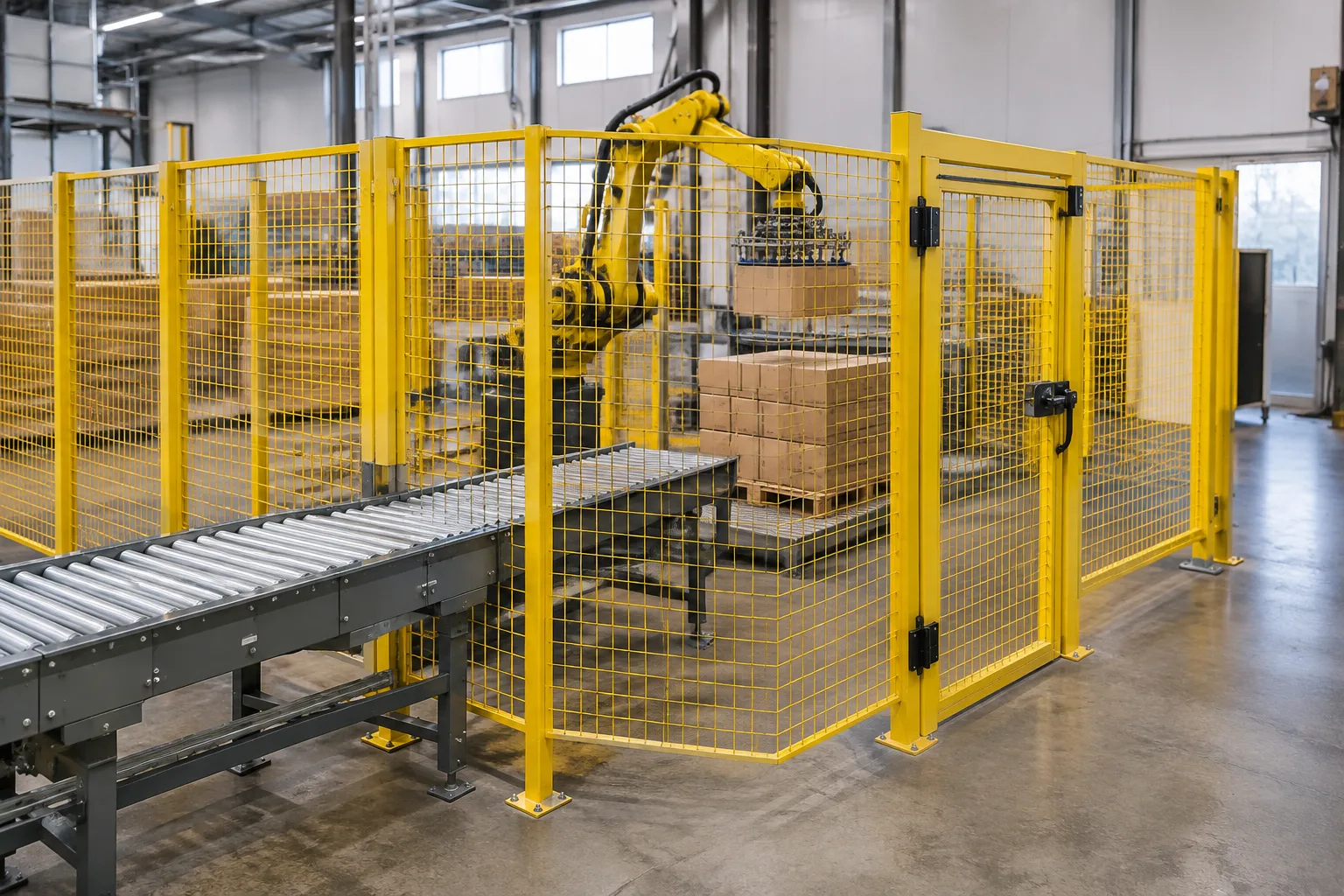
Palletizer safety fencing works best when it is planned as three separate guarding problems: the infeed conveyor, the stacking zone and the full-pallet discharge. Fixed guards close every side where nobody needs routine access. Interlocked doors serve maintenance and changeover, and the pallet exit is a controlled opening protected by sensing devices rather than a gate that someone must open. Forklift lanes then run along the outside of the perimeter, so trucks never need to enter the hazard zone.
Getting this layout right at the drawing stage separates a palletizer cell that runs smoothly from one where operators prop doors open or forklifts clip the fence every shift. Below, we explain how our design team at Bhosari MIDC, Pune approaches each zone for end-of-line projects in Chakan, Ranjangaon, Talegaon and across Maharashtra.
Why palletizer machine guarding needs a zone-by-zone approach
A palletizer packs several hazards into a small footprint: conveyor nip points and transfer points at the infeed, a robot arm or layer-forming head moving at speed in the stacking area, and heavy moving loads at the discharge. Each zone also has different access needs. Product flows in continuously, operators replenish empty pallets and slip sheets, maintenance teams reach grippers and sensors, and forklifts or pallet conveyors remove finished loads.
A single closed box around the machine rarely survives these demands. The suitability of any guarding system must be assessed against the machine's hazards and the complete safety design, and that starts with a documented risk assessment. Fencing is the physical layer of the design. Interlocks, sensing devices and control system logic, usually specified by the machine builder or system integrator, complete it.
Guarding the infeed conveyor
The infeed is where cases, bags, crates or shrink-wrapped packs arrive, often through accumulation, turning and layer-forming sections. The aim is to stop hands and bodies reaching moving parts while letting product pass freely.
- Tunnel guarding at the fence line: where the conveyor enters the palletizer perimeter, the opening should be sized to the product, with a tunnel or extended guard so a person cannot reach through to the hazard. ISO 13857 sets safety distances for openings according to their size and which part of the body could reach through, and it is the usual reference for this check.
- Conveyor-side panels: mesh panels along accumulation and turning sections keep people away from rollers and chains. The gap beneath panels and between panel and conveyor frame should be assessed against the same reach criteria.
- Access for jam clearance: infeed jams are frequent, so decide early which panels are fixed guards needing a tool to remove and which are movable, interlocked guards. ISO 14120:2015, which our website references for fixed and movable guards, sets out this distinction.
For longer infeed runs, our conveyor safety fencing uses the same column and panel system as the palletizer cell, so the perimeter stays continuous from the production line to the stacker.
Guarding the stacking zone
On a robotic palletizer, the fence line must sit outside the robot's full reach envelope, including the gripper and the largest load it carries, with the safety distance confirmed during risk assessment. Mesh panels keep the cell visible, which helps operators spot a misaligned layer or a dropped case without opening a door. Our robotic fencing systems are built for exactly this kind of defined safeguarding perimeter around automated operations.
Layer and gantry palletizers bring different concerns: elevator hoists, layer plates and overhead movement. Here the fence often needs taller sections near the hoist and careful detailing where the machine frame meets the panels, so no gap opens up between the two.
Maintenance doors in the stacking zone
Maintenance teams need regular entry to change grippers, clean sensors and recover fallen products. Place doors where technicians actually work, not where the drawing has spare space. Single-hinge, double-hinge and folding safety doors suit different clearances, and doors are normally fitted with interlocking devices that connect to the machine's safety circuit. ISO 14119 is the standard covering interlocking devices associated with guards. Our machine guard systems include doors, locks and connectors designed to accept these devices. A common error is placing doors that are awkward to use, which invites bypassing; our article on mistakes to avoid with robotic fencing covers this and similar pitfalls.
Full-pallet discharge without blocking forklift access
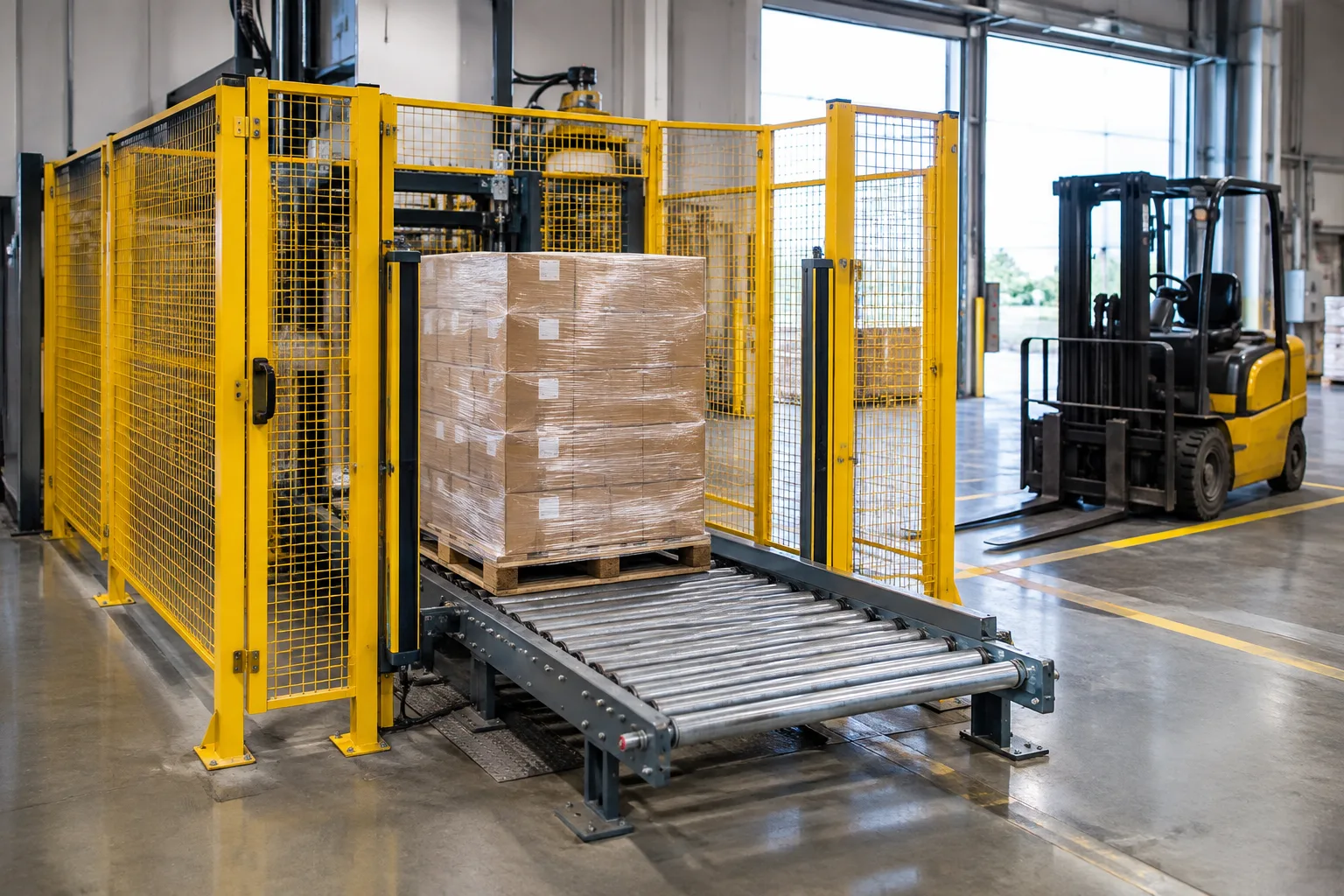
The discharge is where most palletizer layouts go wrong, because it is the one point where a large opening is unavoidable. The practical answer is to keep the forklift outside the cell entirely.
- Run finished pallets out on a pallet conveyor. A chain or roller conveyor carries the loaded pallet through an opening in the fence to a pick-up station outside the perimeter.
- Protect the opening with sensing devices, not just fencing. Muting light curtains or similar devices, designed into the control system by the integrator, allow a pallet to pass while stopping the machine if a person tries to walk in. The fence is detailed around these devices so there is no way to step around them.
- Size the pick-up station for buffering. A station that holds more than one pallet gives forklift drivers time, so they are never tempted to reach into the cell.
- Protect fence corners on forklift routes. Columns at the discharge face forklift traffic daily. Heavier columns, floor-anchored bases and separate barriers or floor marking along the truck lane reduce the risk of panels being knocked out of position.
Layouts where forklifts pick directly from the stacking position inside the cell are harder to safeguard, because the truck and driver must enter a hazard zone. Where this cannot be avoided, it needs an interlocked access gate tied to a safe stop of the palletizer, and it should be treated as a priority item in the risk assessment.
Keeping operator access practical
Operators load empty pallet magazines, refill slip sheets, change labels and reset faults. Each task should be possible from outside the fence wherever possible:
- Empty pallet magazines loaded by forklift from outside, through a guarded opening similar to the discharge.
- Slip sheet and label stations positioned at the perimeter, with only the dispensing mechanism inside.
- HMI panels and reset buttons mounted outside the fence, with a clear view into the cell.
When routine tasks need a door, the door gets opened hundreds of times a week. Designing those tasks out of the cell is the most reliable way to keep automation safety fencing respected on the shop floor.
Choosing panels, columns and finishes
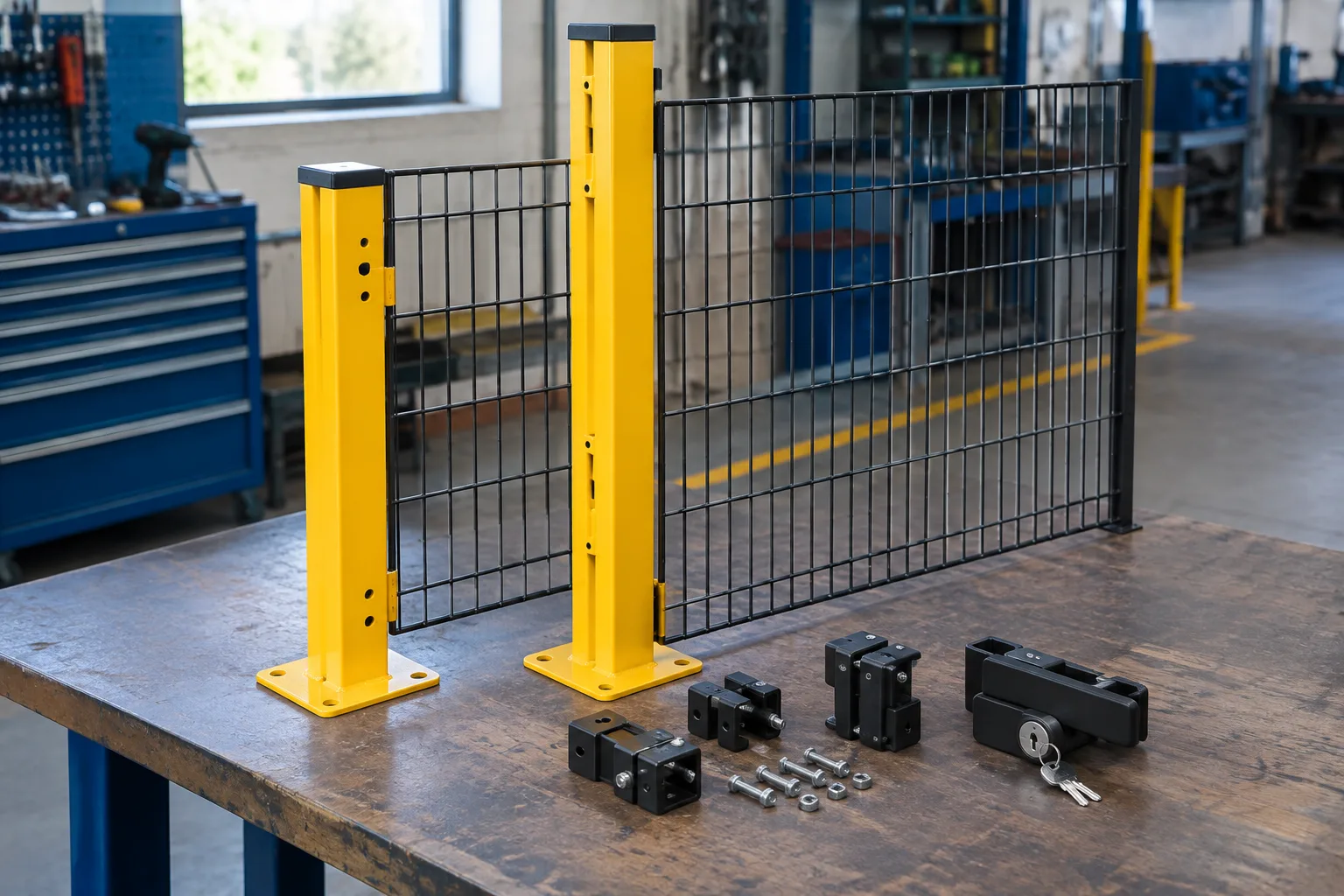
Swiza Safetech manufactures palletizer safety fencing from modular steel wire mesh panels on 40x40 and 40x60 column series. The 40x60 column offers a heavier section, which is generally preferred for taller runs, longer spans or perimeters exposed to forklift traffic, while the 40x40 series suits standard cell perimeters. Our published specifications include 20x100x3 mm mesh panels for the applicable product, and our catalogue lists standard fencing heights and panel widths, with custom sizes made to the layout.
Our product literature also describes impact testing of specified 40x40 and 40x60 fencing configurations, with ARAI impact inspection reference FMCE/3100015707(22-23)/SS/548(22-23). That test applies to the configurations described, so we confirm the specification for each project rather than assume it. Panels are available powder-coated in multiple finish colours. You can browse the full range of custom industrial safety fencing, including doors, locks and connectors.
What to share for a palletizer fencing quotation
For project-specific machine guarding, the more we know at the start, the fewer revisions later. Please share:
- Palletizer layout drawing (DWG or PDF) showing the infeed, stacking area, pallet magazine and discharge.
- Palletizer type (robotic, layer or gantry) and the robot model or reach envelope where relevant.
- Forklift routes, pick-up points and any pallet conveyor details.
- Required door positions, door types and the interlocking devices your integrator will fit.
- Any height, colour or finish requirements and the site location for installation planning, including shutdown windows.
Whether you are building a new end-of-line cell or retrofitting automated production line fencing around an existing palletizer in Pune, Pimpri-Chinchwad or Mumbai, share your machine layout with our technical team through our contact page to discuss the design or request a quotation.
Frequently asked questions
How high should palletizer safety fencing be?
There is no single height for every palletizer. The height and the distance of the fence from the hazard are determined together, typically using ISO 13857 safety distances and the findings of your risk assessment. Our catalogue lists standard fencing heights, and taller sections can be made where the risk assessment calls for them.
Can forklifts collect pallets without entering the palletizer cell?
Yes, and this is the preferred layout. A pallet conveyor carries finished loads through a protected opening to a pick-up station outside the fence, so the forklift never enters the hazard zone. The opening is usually protected by sensing devices such as muting light curtains specified by the integrator.
Should I choose 40x40 or 40x60 columns for a palletizer?
The 40x40 column series suits standard cell perimeters, while the heavier 40x60 series is generally chosen for taller runs, longer spans or areas exposed to forklift traffic. Many palletizer projects use both, with 40x60 columns at the discharge and along truck lanes. Our team can recommend a mix once we see your layout.
Can safety fencing be added to an existing palletizer?
Yes. Modular fencing is well suited to retrofits because panels, columns and doors can be configured around existing machines, conveyors and floor conditions. Share your current layout and access requirements and we will propose a configuration that fits.
Does fencing alone make a palletizer safe?
No. Fencing provides the physical barrier, but complete safety depends on a proper risk assessment, interlocks, sensing devices, control system design, correct installation and ongoing maintenance. We design the fencing to integrate with the safety devices your machine builder or integrator specifies.
