- Get in Touch
- +91 96840 33261
- Location
- Pune Maharashtra India
- Mail Us
- sales1@swizasafetech.in
Perimeter Safety Fencing Height and Safety Distance: How to Size Plant Guarding So No One Can Reach Over, Under or Through
- Swiza Safetech
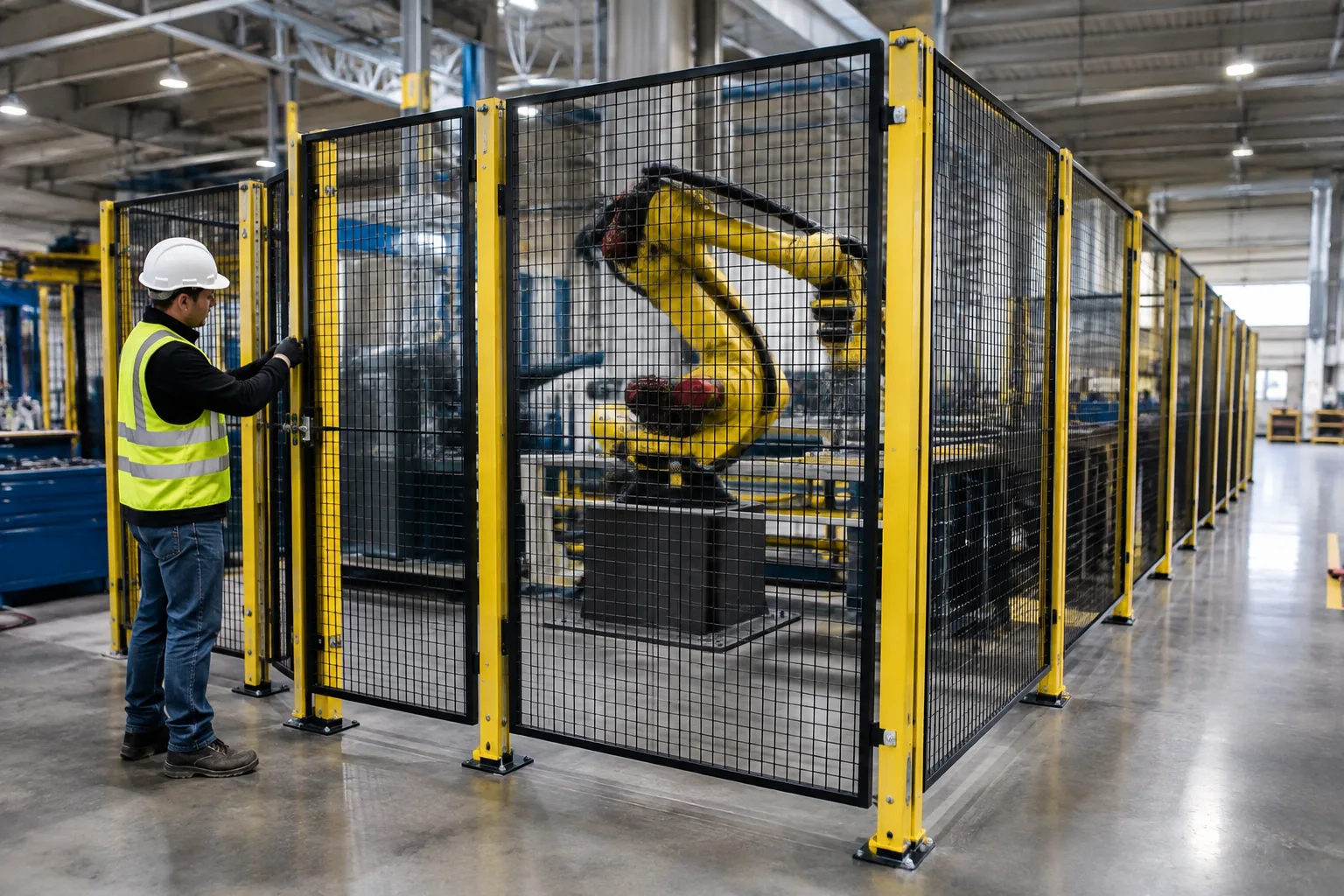
The correct perimeter safety fencing height and safety distance are never chosen separately. Height, distance from the hazard and mesh opening size work as one system: a lower fence must stand further back from the danger zone, and a fence placed close to a machine needs smaller openings. ISO 13857 sets out how these values relate, and ISO 14120 expects fixed and movable guards to be designed with those safety distances in mind.
If you are planning industrial plant perimeter guarding around robots, presses, conveyors or test rigs, size four things before you order a single panel: reach over, reach through, reach under, and the stopping distance behind every door. This guide walks through each one in practical terms.
Why perimeter safety fencing height and safety distance must be sized together
Operators do not just walk into hazards. They lean, stretch, crouch and reach with tools in hand, often while trying to clear a jam quickly. A fence only protects workers if it defeats all of those movements.
ISO 13857 (Safety of machinery: safety distances to prevent hazard zones being reached by upper and lower limbs) is the international reference for this. It gives tables that combine three inputs:
- The height of the hazard zone above the floor (a robot gripper, a press tool, a conveyor nip point).
- The height of the protective structure, meaning the top edge of your fence.
- The horizontal distance between the fence and the hazard.
Change one input and the others must be rechecked. That is why a fence that is perfectly safe around one machine can be unsafe when the same panels are moved closer to another.
Reaching over: how tall should perimeter safety fencing be?
The reach-over question depends on where the hazard sits and how close the fence stands to it. ISO 13857 treats a hazard zone at or above 2700 mm as out of upward reach for a high-risk situation, so no structure is needed to stop someone reaching up to it. Below that height, the standard's tables tell you the minimum horizontal distance needed for a given fence height.
Two practical points follow from the standard:
- Very low barriers do not count as reach-over protection. ISO 13857 does not include protective structures under 1000 mm in its reach-over tables, because they do not sufficiently restrict body movement. A knee-high rail marks a zone; it does not guard it.
- A taller fence lets you work closer. Where floor space is tight, as it often is on crowded lines in Pimpri-Chinchwad and the Chakan auto belt, raising the fence is usually the simplest way to bring it nearer to the machine while keeping the required distance.
Also consider what operators might climb on. Nearby racking, pallets, control cabinets or stair landings effectively raise the person, so measure from where someone could actually stand, not only from the floor.
Reaching through: mesh openings and distance from the hazard
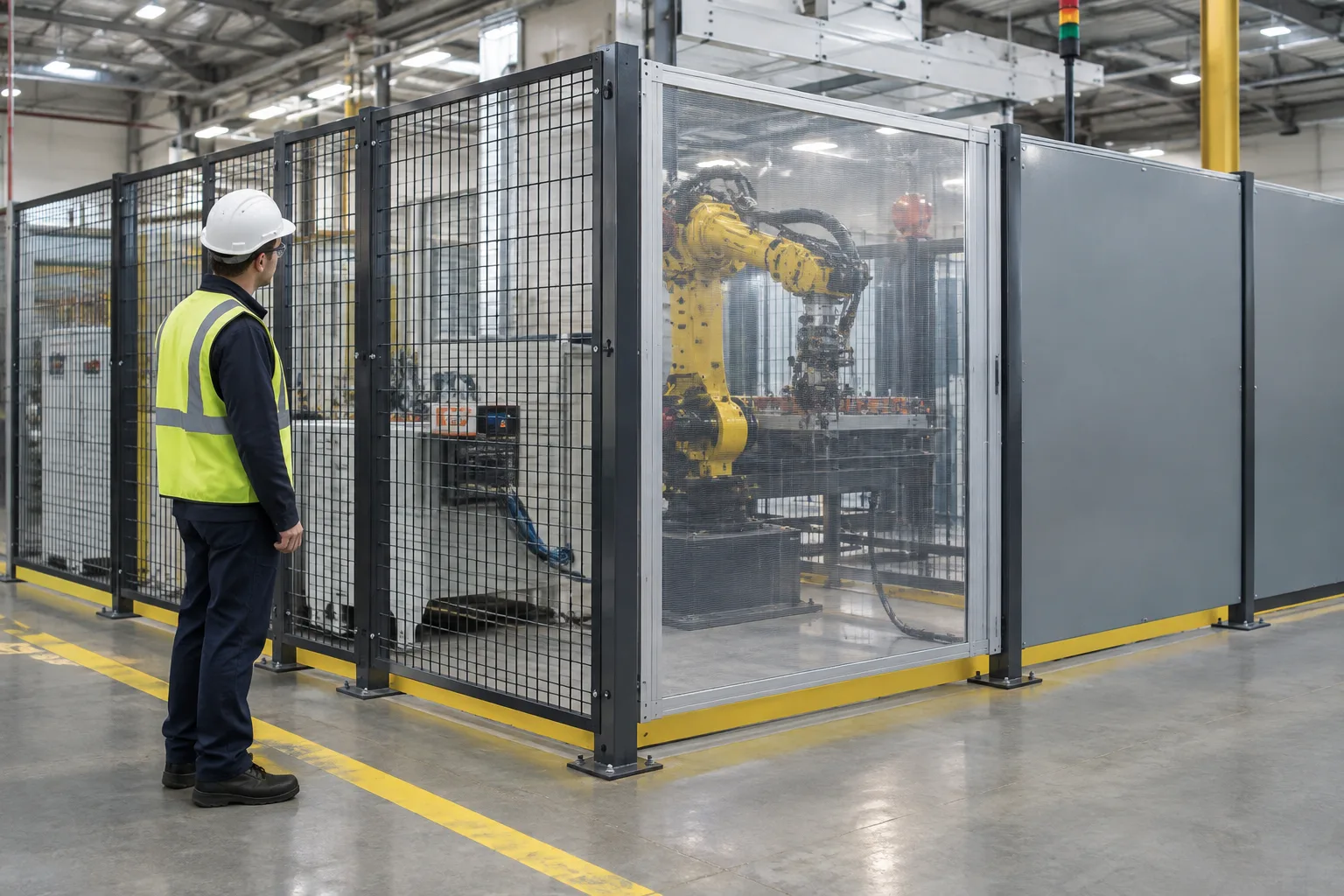
Every opening in a fence is a potential path for fingers, a hand or a whole arm. ISO 13857 assigns a minimum safety distance to each opening size and shape (slot, square or round), measured from the opening to the nearest hazard. Larger openings let more of the limb through, so they need more distance.
Swiza Safetech's wire mesh fencing panels use a 20x100 mesh. For a rectangular opening like this, the narrow 20 mm dimension is what limits how far a hand can pass, and it is the figure to check against the ISO 13857 table along with the actual distance from the panel to the hazard on your layout. If a hazard has to sit very close to the fence line, switch that section to a solid infill:
- Polycarbonate panels block reach-through and keep the process visible, useful for inspection and for containing small parts or coolant spray.
- Sheet metal panels suit welding cells and areas where sparks, spatter or flying debris must be contained.
Mixing mesh, polycarbonate and sheet metal on the same modular safety fencing system lets you match infill to the hazard section by section instead of overspecifying the whole perimeter.
Reaching under: the floor gap and column anchoring
The gap between the floor and the bottom edge of the panel is easy to overlook. ISO 13857 also covers lower-limb reach, so a gap that lets a foot or leg slide under the fence must be kept within the limits the standard sets for the distance to the hazard.
In real plants the floor is rarely flat. Drains, expansion joints and old foundation plinths all create local gaps. A column-and-panel system helps here: panels can be set to follow the floor line, and columns are fixed with anchor fasteners so the fence cannot be shifted or lifted to open a crawl space. Where long or tall runs face forklift traffic or impact, as in heavy fabrication or perimeter fencing for steel plants, the larger 40x60 column section gives more stiffness than the 40x40 series.
Doors and interlocks: the distance people forget
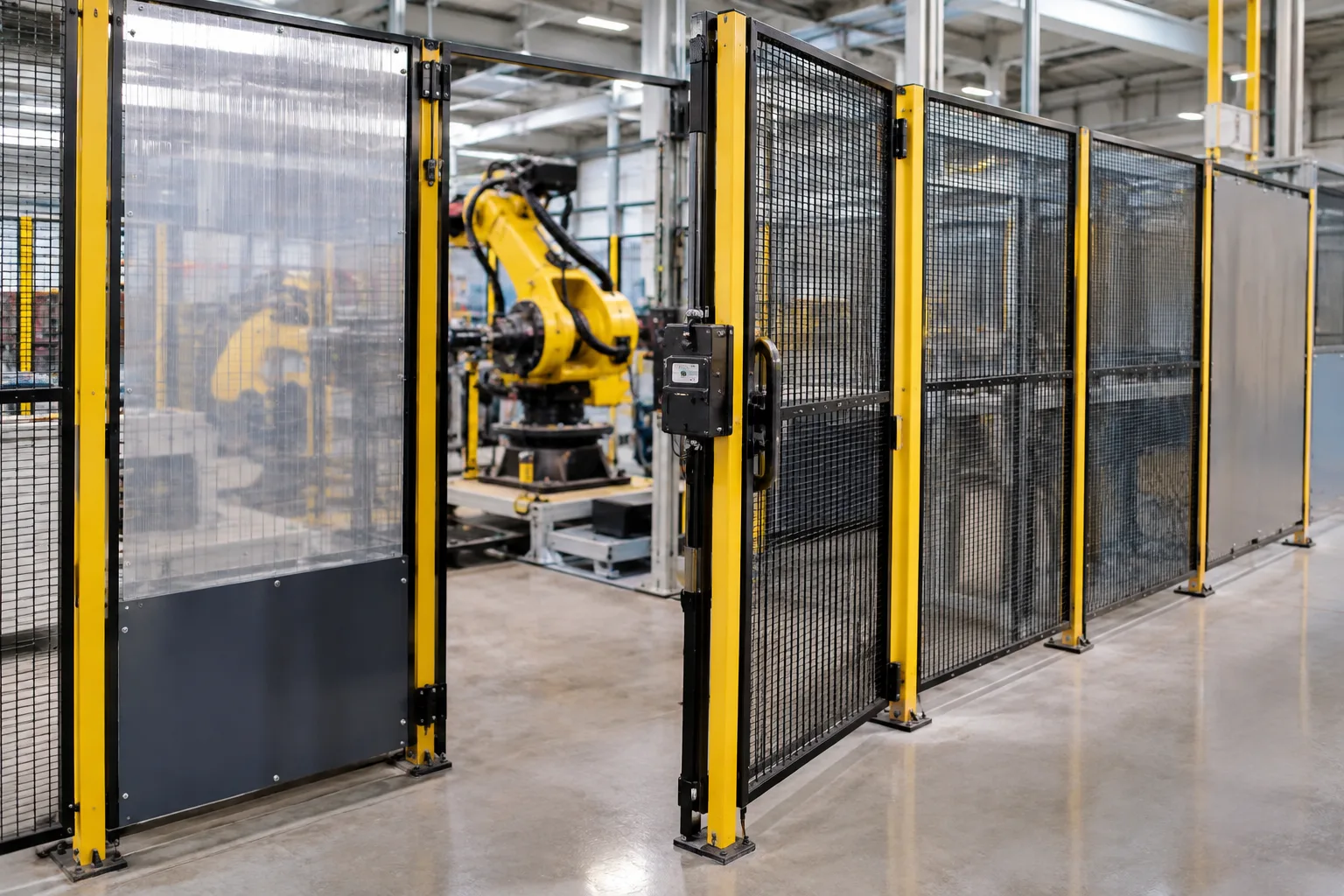
A perimeter is only as safe as its access points. When an interlocked door opens, the machine needs time to stop. ISO 13855 (positioning of safeguards with respect to the approach speeds of parts of the human body) explains how to relate a machine's stopping time to the distance a person can cover after opening a guard. ISO 14119 covers the design and selection of the interlocking devices themselves.
In practice:
- Measure the real stopping time of the machine, not the brochure figure.
- If the hazard cannot stop before a person reaches it, use a guard locking device (an electric door lock that holds the door shut until motion has ceased).
- Choose the door type for the task: single-hinge or double-hinge for walk-in access, folding or double-open doors where trolleys and maintenance equipment must pass.
For guarding at individual machines rather than the full perimeter, our machine guarding fence options follow the same reach and stopping-distance logic.
A practical sizing checklist for perimeter guarding for factories
- Map every hazard. List each moving part, its height above the floor and its maximum reach, including robot over-travel.
- Mark where people stand. Note platforms, steps, racking and anything a person could climb.
- Choose fence height and position together using the ISO 13857 reach-over tables.
- Check every opening (mesh, gaps between panels, cable entries) against the reach-through distances.
- Check the floor gap along the entire run, not only at one point.
- Size doors and interlocks from measured stopping times, following ISO 13855 and ISO 14119.
- Plan for change. If the line will be reconfigured, keep spare panels and columns so the new layout can be guarded to the same distances.
Conveyors deserve their own check because hazards run the full length of the line. Our page on conveyor safety fencing in Pune covers how this applies to material handling zones.
How Swiza Safetech sizes industrial plant perimeter guarding
As a Make in India plant perimeter safety fence manufacturer based at Bhosari MIDC, Pune, Swiza Safetech manufactures its fencing to ISO 14120 for fixed and movable guards, and the fencing has been tested by ARAI, with a published test report and certificate. Our modular 40x40 and 40x60 column systems, 20x100 mesh panels, polycarbonate and sheet metal infills, doors and interlocks are combined into a layout tailored to your machinery configuration.
The aim, in our own words, is a perimeter safety project that will "ensure workforce safety, comply with regulations, and will not be a burden on productivity." The same Indian-made fence has been installed on a robotic line in New Zealand inaugurated by former Prime Minister Jacinda Ardern, and we supply across Maharashtra, India and overseas. For background on why plants are investing in this, read why industrial safety fencing is critical for Indian manufacturing plants.
If you have a layout drawing or a list of machines, share it with us through our contact page and we will help you work out fence height, position and infill for every section of your perimeter.
Frequently asked questions
What is the minimum height for perimeter safety fencing?
There is no single height that suits every plant, because the required height depends on how high the hazard is and how far the fence stands from it. ISO 13857 relates these values in its tables, and it does not count structures under 1000 mm as reach-over protection. A hazard at or above 2700 mm is treated as out of upward reach in a high-risk situation.
Is 20x100 wire mesh safe close to a machine?
It depends on the distance between the mesh and the nearest hazard. ISO 13857 sets a minimum safety distance for each opening size and shape, so the 20 mm narrow dimension must be checked against the actual distance on your layout. Where a hazard sits very close to the fence, polycarbonate or sheet metal panels can be used for that section.
How do I make sure a door in the perimeter fence is safe?
Measure the machine's real stopping time and compare it with how quickly a person can reach the hazard after opening the door, as described in ISO 13855. If the machine cannot stop in time, use an electric door lock or guard locking interlock that keeps the door shut until motion stops. ISO 14119 covers the selection of these interlocking devices.
Can modular perimeter fencing be moved if we change our line layout?
Yes, Swiza Safetech's 40x40 and 40x60 column-and-panel systems are modular and can be reconfigured. Each time the layout changes, the fence height, distance from the hazard and opening sizes should be rechecked, because a fence that was safe in one position may not be safe closer to another machine.
Does Swiza Safetech's perimeter fencing comply with ISO 14120?
Swiza Safetech manufactures its fencing to ISO 14120 for fixed and movable guards, and the fencing has been tested by ARAI with a published test report and certificate. Correct safety distances still depend on the layout, so each project should be sized to your machinery configuration.
