- Get in Touch
- +91 96840 33261
- Location
- Pune Maharashtra India
- Mail Us
- sales1@swizasafetech.in
Robotic Welding Cell Fencing: Choosing Panels, Viewing Screens and Doors for Arc Flash, Spatter and Fume
- Swiza Safetech
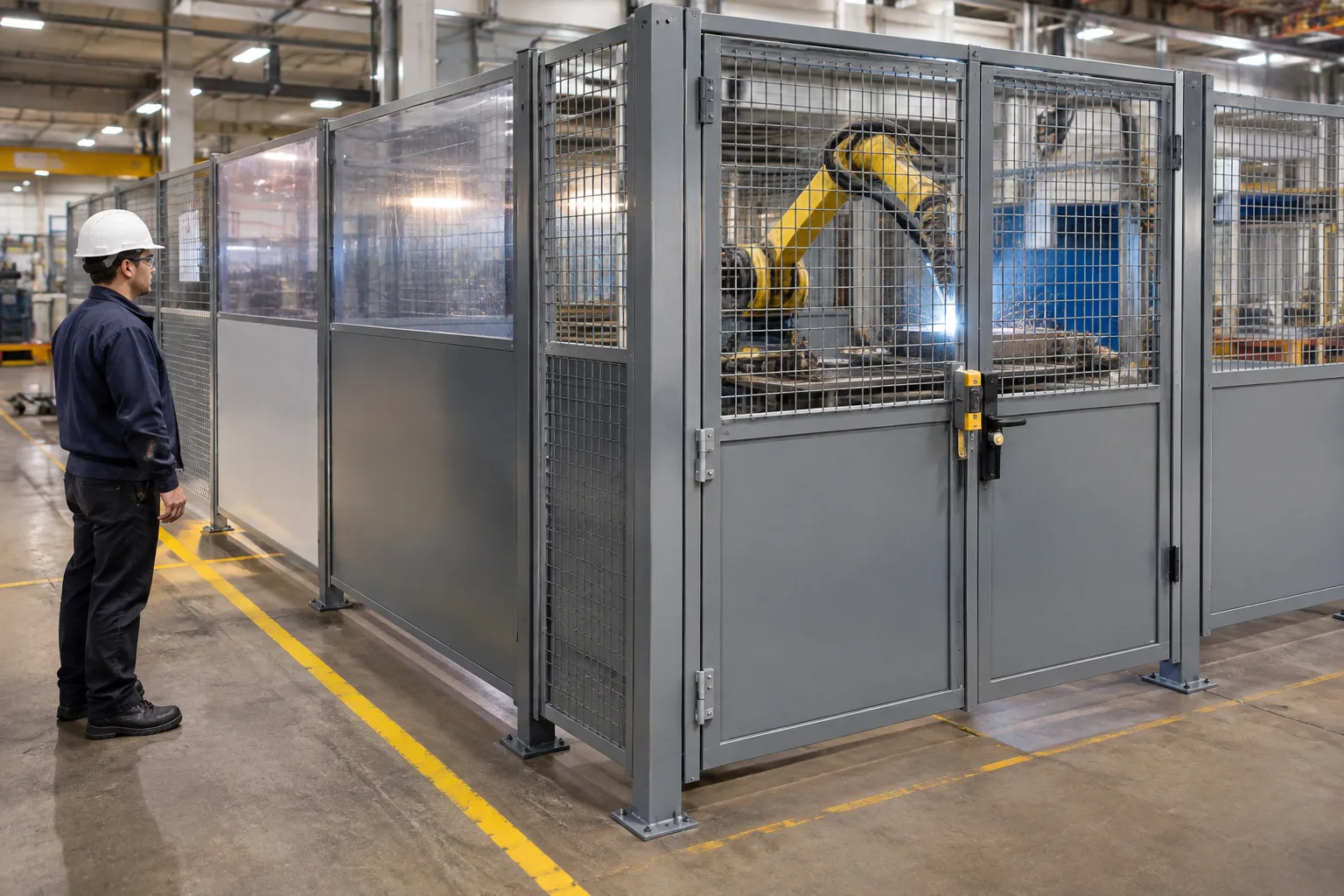
Robotic welding cell fencing has to do more than stop people reaching a moving robot. It must also control arc light, contain weld spatter and work alongside fume extraction, which is why the panel type, the position of any viewing screens and the placement of doors matter as much as the fence line itself. In practice, that usually means a steel mesh perimeter for the physical barrier, opaque or filtered infill wherever arc light could reach eye level, and doors located away from the direct line of the torch.
The sections below explain how each of these hazards affects your choice, so your team can specify a welding cell enclosure that protects operators without making the cell difficult to load, maintain or ventilate.
What makes robotic welding cell fencing different
A standard robotic fencing cell for handling or assembly is mainly a guard against mechanical hazards: impact, crushing and trapping by the robot arm or tooling. A welding robot adds three process hazards that a plain mesh fence does not address on its own:
- Arc radiation: intense visible light plus ultraviolet and infrared radiation that can harm the eyes and skin of people working nearby, even at a distance.
- Weld spatter: hot metal droplets that travel outward from the weld zone and can pass through open mesh at low angles.
- Welding fume: airborne particulate and gases that need to be captured by extraction, not trapped inside a sealed box.
ISO 10218, the international standard for industrial robot safety, treats the robot system and its surroundings as one safeguarding design. That is a useful way to think about a welding cell: the fence, screens, doors, extraction and controls should be planned together, based on a proper risk assessment and guarding design, rather than added piece by piece after commissioning.
Arc flash: where mesh is enough and where it is not
Steel mesh safety panels give excellent visibility and airflow, but they do not block arc light. In a robotic welding cell, the usual approach is to divide the perimeter by exposure:
- Panels facing walkways, workstations or other operators: fit opaque or filtered infill over the height range where arc light could reach a person's eyes.
- Panels facing a wall or a dead zone: plain mesh may be acceptable if no one can be exposed from that side.
- Upper sections above the arc line of sight: mesh is often retained here to allow light and air into the cell.
For screens and curtains intended for arc welding, EN 1598 is the European standard that covers transparent welding curtains, strips and screens. If your cell uses this type of screening, ask your supplier for product-specific evidence against that standard rather than accepting a general claim.
Viewing screens: placing them where they are actually useful
Operators and maintenance staff need to watch the weld without stepping inside the cell. Viewing screens should be positioned where supervisors naturally stand, typically beside the loading station or the HMI, and set at a comfortable viewing height. Avoid placing a viewing panel directly opposite the torch at close range, and keep it away from the main spatter path so the screen does not become pitted and unusable within weeks.
Weld spatter: panel finish, height and the floor gap
Spatter affects both the safety of people outside the cell and the life of the fencing itself. Points to cover in your specification:
- Mesh aperture: Swiza Safetech publishes specifications for 20x100x3 mm mesh panels. Smaller openings help with reach-through, but they do not stop spatter on their own, so solid infill is usually added near the weld zone.
- Bottom gap: spatter and small parts can roll out under the fence. A lower solid kick panel or reduced floor clearance helps contain them.
- Finish: powder-coated panels are standard across much of the fencing range and available in multiple colours, but hot spatter can mark any coated surface. Where the robot welds close to the perimeter, plan for replaceable shielding on the inside face.
- Reach and openings: ISO 13857 sets out safety distances related to opening size and reach, so the mesh size, fence height and distance from the robot's working envelope should be checked together.
For more on mesh construction, see our page on welded wire mesh fencing.
Fume: keeping extraction and the fence working together
The instinct to fully enclose a welding cell with solid panels can create a new problem: fume builds up inside and drifts out every time the door opens. A better approach is to treat the fence as part of the extraction design.
- Agree the extraction method (torch-mounted, overhead hood or downdraft) with your integrator before the fencing layout is finalised.
- Leave clear routes and mounting points for ducting, hoods and cable trays through or above the fence line.
- Use mesh where airflow is needed and solid panels only where arc light or spatter demands it.
- Keep access for filter changes and duct cleaning so maintenance staff are not tempted to remove panels.
Fume control remains the responsibility of the extraction system; the fencing simply needs to support it and not obstruct it.
Door placement in a robotic welding cell
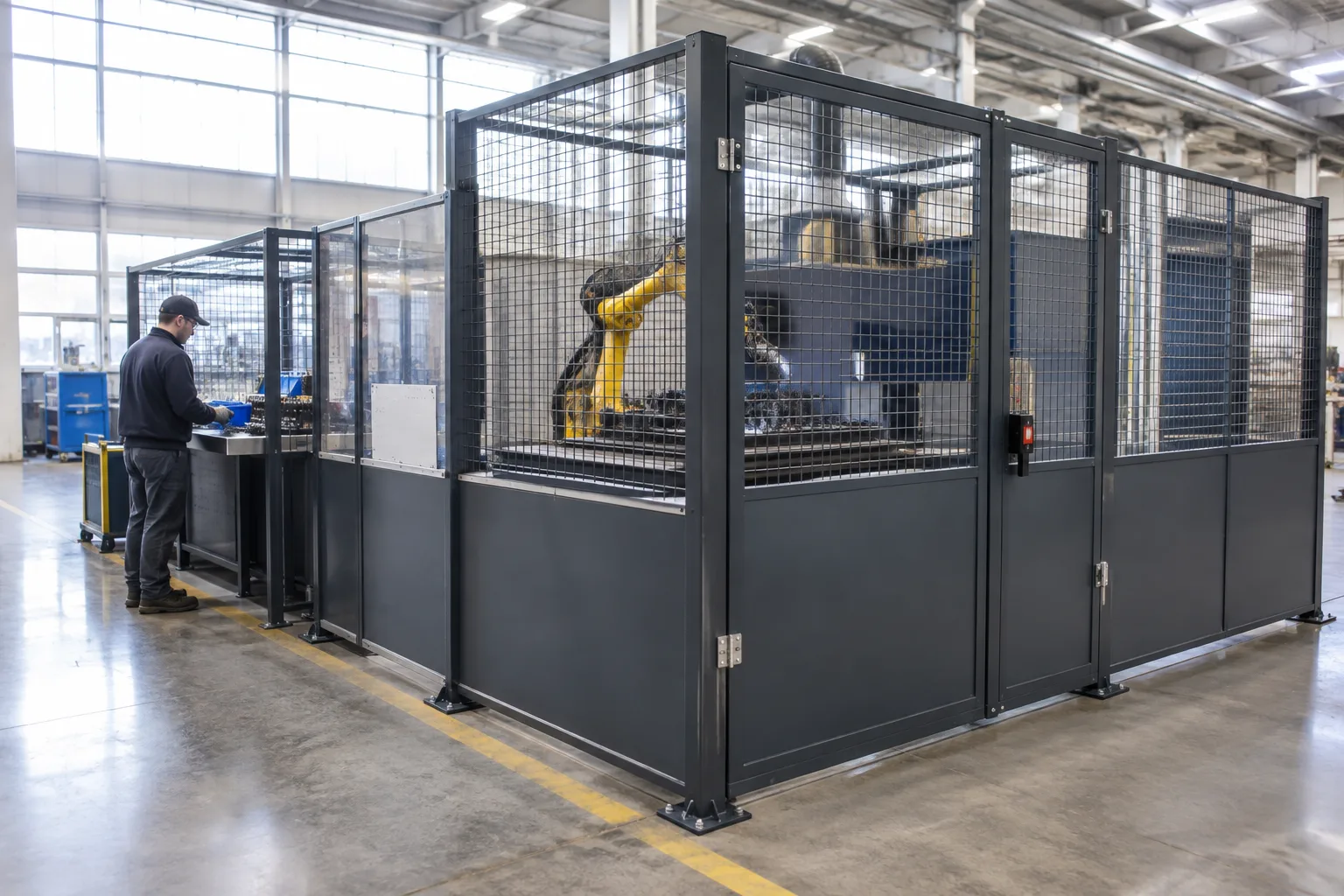
Doors are where most real-world exposure happens, so their location deserves careful thought. In a robot cell safety fence for welding:
- Keep personnel doors out of the torch's line of sight. Place them at the end of the cell or behind a screened section, not opposite the weld fixture.
- Separate loading from maintenance access. Two-station positioners and turntables let operators load one side while the robot welds the other; the operator side needs screening between stations.
- Size doors for the job. Single-hinge, double-hinge and folding safety doors suit different needs, from daily access to occasional fixture changes or wire drum replacement.
- Interlock movable guards. Doors that open during production should have a locking or interlocking arrangement connected to the robot controller by your integrator, so the robot stops before anyone can reach the hazard zone.
ISO 14120:2015, which covers fixed and movable guards, is a useful reference when deciding which panels should be fixed and which need to open. You can review our safety fencing doors and accessories for the door and lock options in the range.
Structure: choosing between 40x40 and 40x60 columns
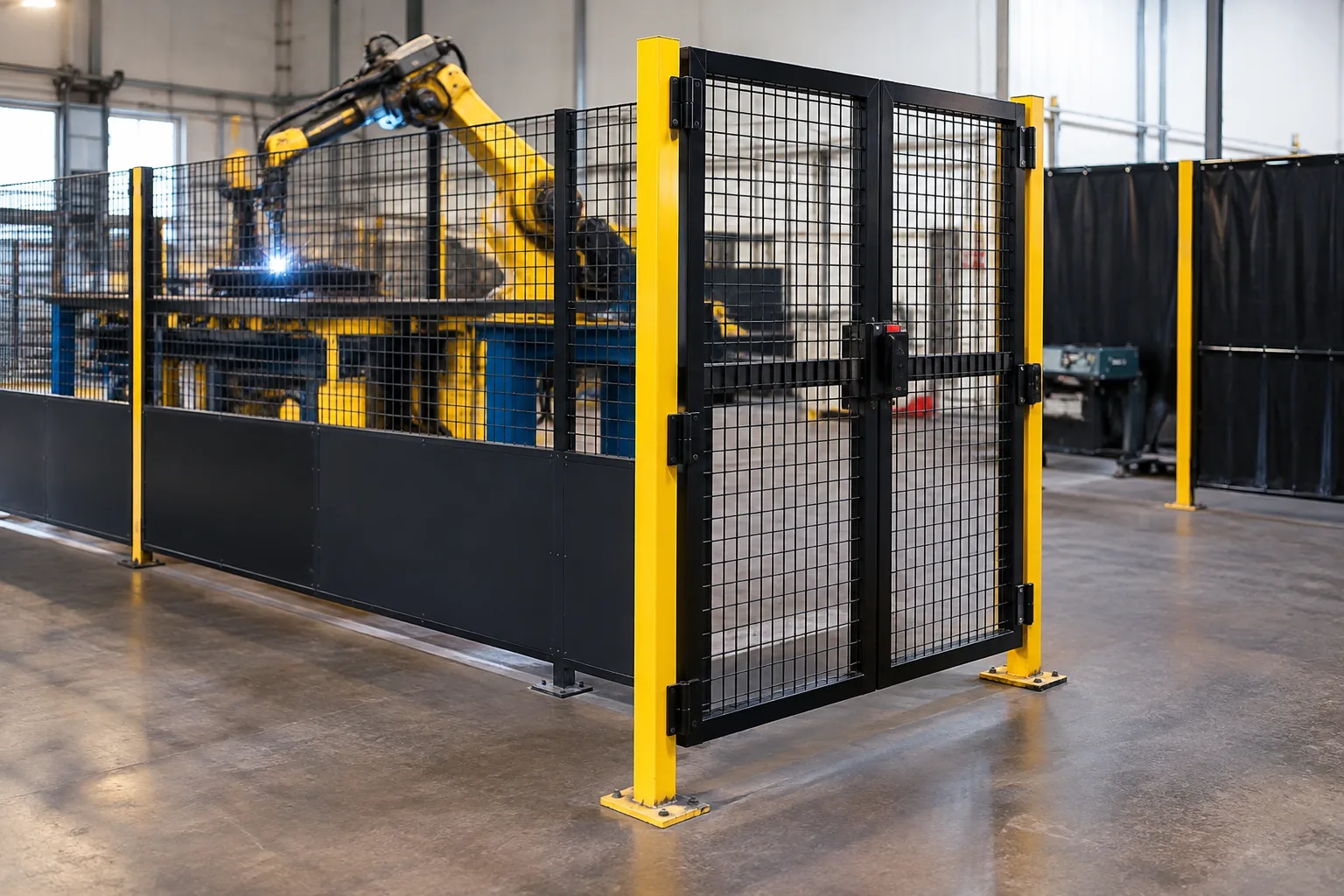
Welding cells often carry extra load from infill panels, screens and ducting supports. The 40x40 column series suits typical cell perimeters, while the 40x60 column series offers a stiffer section for taller fences, wider spans or panels carrying heavier infill. Published Swiza Safetech literature describes impact testing of specified 40x40 and 40x60 fencing configurations by ARAI (Automotive Research Association of India), under inspection reference FMCE/3100015707(22-23)/SS/548(22-23). That test applies to the configurations described, so confirm that your proposed layout matches before relying on it.
For a wider look at protective features, read about safety features of robotic cells in industrial settings.
Sourcing robotic welding cell fencing in Pune and across India
Robotic welding is common across automotive and component plants in Chakan, Bhosari, Pimpri-Chinchwad, Talegaon and Ranjangaon. As a robotic cell fencing manufacturer in India operating from Bhosari MIDC, Swiza Safetech designs and manufactures modular machine guarding systems that can be configured around welding robots, positioners and loading stations. Our guidance on choosing the right robotics fencing solutions covers the wider selection process.
To prepare an accurate proposal for robotic welding cell fencing, share:
- Cell layout drawing showing the robot, positioner, fixtures and robot reach envelope
- Welding process and which sides of the cell face walkways or workstations
- Required door positions, sizes and interlock arrangements
- Extraction method and ducting routes
- Preferred fence height, column series and finish colour
Fencing is one part of the complete safety design, and its suitability must be assessed against the machine's hazards and your risk assessment. Share your machine layout with our technical team to discuss your welding cell and request a quotation.
Frequently asked questions
Is mesh fencing enough for a robotic welding cell?
Mesh fencing provides the physical barrier against the robot, but it does not block arc light or fully contain spatter. Most welding cells combine mesh with opaque or filtered infill on sides that face people. The final mix should come from your risk assessment.
Where should doors be placed on a robotic welding cell fence?
Personnel doors are best placed away from the torch's direct line of sight, typically at the end of the cell or behind a screened section. Doors used during production should have an interlocking or locking arrangement connected to the robot controller so the robot stops before anyone reaches the hazard zone.
Should a robotic welding cell be fully enclosed with solid panels?
Not usually. Fully solid enclosures can trap welding fume and make extraction less effective. Solid panels are generally used where arc light or spatter requires them, with mesh retained elsewhere for airflow and visibility.
Which column series suits robotic welding cell fencing, 40x40 or 40x60?
The 40x40 column series suits many standard cell perimeters, while the 40x60 series gives a stiffer structure for taller fences, wider spans or panels carrying heavier infill and screens. Share your layout and panel requirements so the right series can be recommended.
What information does Swiza Safetech need to quote robotic welding cell fencing?
Send a layout drawing with the robot reach envelope, the welding process, door positions and sizes, interlock requirements, extraction method and preferred fence height and finish. This allows the team at Bhosari MIDC, Pune to prepare a project-specific fencing layout and quotation.
