- Get in Touch
- +91 96840 33261
- Location
- Pune Maharashtra India
- Mail Us
- sales1@swizasafetech.in
Test Rig Safety Guarding: Enclosing Engine, Gearbox and Component Test Benches
- Swiza Safetech
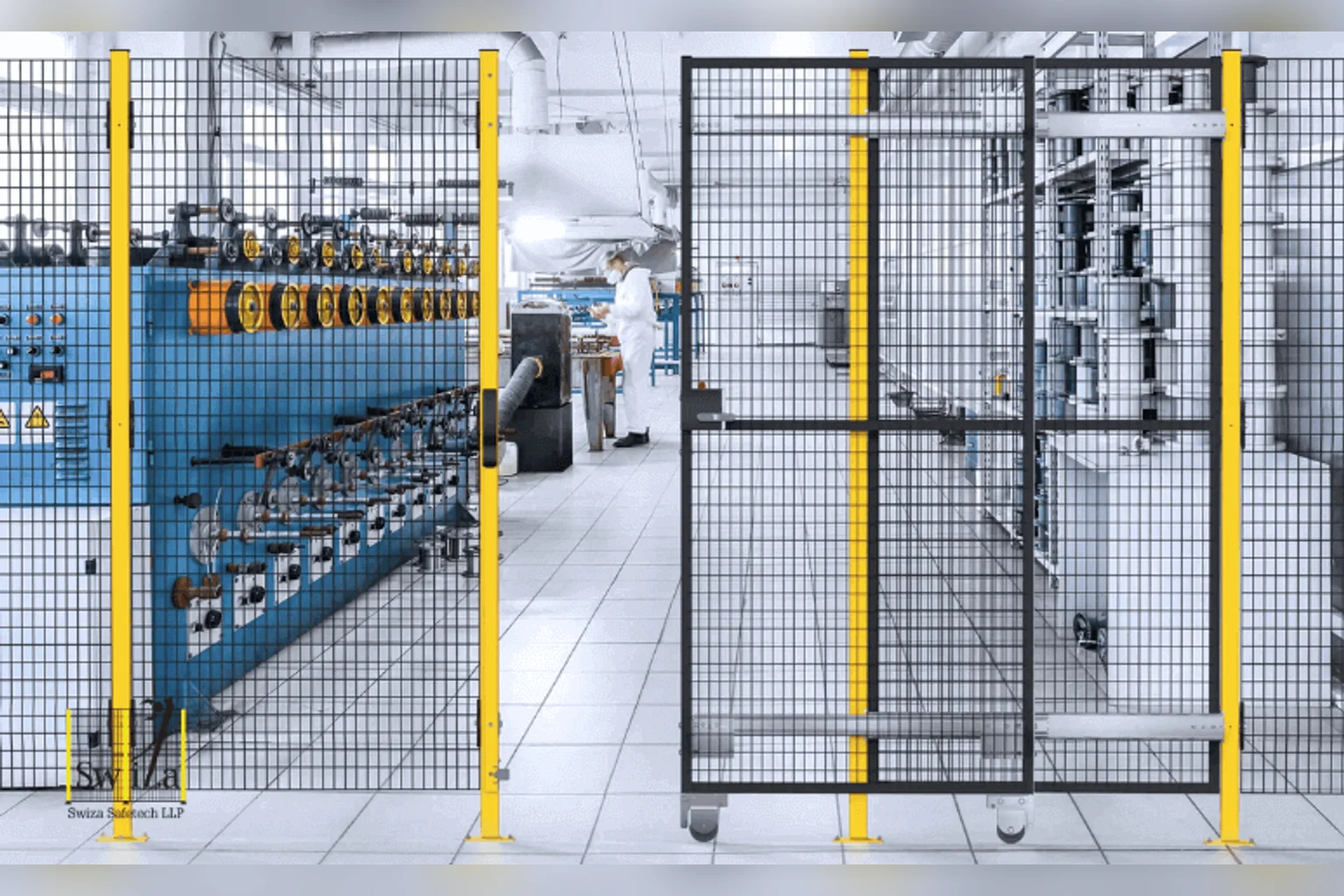
Test rig safety guarding is the physical enclosure around an engine, gearbox or component test bench. It keeps people away from rotating shafts and couplings, helps contain parts released during a failure, and controls when and how technicians enter. A practical enclosure is usually built from fixed steel mesh panels for the perimeter, interlocked doors for routine access, and solid or acoustic sections only where the risk assessment calls for them.
The right design depends on the rig's energy, speed and maintenance routine, not on a standard fence height alone. Swiza Safetech LLP manufactures modular machine guarding at Bhosari MIDC, Pune, and supplies test rig safety fencing to automotive, component and machine-building plants across Pimpri-Chinchwad, Chakan, Talegaon and Ranjangaon. Below is how our technical team approaches a test bench enclosure, and where fencing ends and other engineering measures begin.
Why test benches need a different guarding approach
A production machine runs a known, repeatable cycle. A test rig is deliberately pushed towards its limits: engines run at high load, gearboxes go through endurance cycles and components are sometimes taken to failure. That creates four distinct hazards around the bench:
- Rotating shafts and couplings between the dynamometer or drive motor and the unit under test
- Ejected parts such as fasteners, coupling fragments, broken gear teeth, burst hoses and sprayed fluids
- Noise from engines, gear mesh, dynamometers and cooling fans
- Frequent technician access for set-up, instrumentation, changeover and inspection
Each hazard needs its own answer. Test rig guarding that controls reach very well may do nothing for noise, and a door arrangement that makes set-up convenient can weaken the enclosure if it is not interlocked.
Rotating shafts and couplings: guarding at two levels
The drive line between dynamometer and test article is the most common entanglement hazard on a bench. Good practice is to guard it at two levels: a close guard over the shaft and couplings (often a hinged or removable shaft tunnel supplied with the rig), and a perimeter enclosure that keeps people out of the whole zone while the rig is running.
ISO 14120:2015, which our website references in relation to fixed and movable machine guards, sets general requirements for the design and construction of guards, including their strength, how they are retained and when fixed or movable guards are appropriate. Reaching through or over a fence is addressed by ISO 13857, which relates opening sizes and guard heights to the distance from the hazard. In practice, mesh aperture, panel height and the floor gap must be checked against how far the shaft sits from the fence line. That is why we ask for layout drawings before recommending a panel, and why our machine guard systems are configured per project rather than sold as a fixed kit.
Ejected parts: decide what the enclosure must stop
The first engineering question is what could leave the rig, and with how much energy. A loose bolt from a slow-running gearbox rig is a very different problem from a coupling failure at engine speed.
Swiza Safetech publishes ARAI impact inspection information (reference FMCE/3100015707(22-23)/SS/548(22-23)), and our product literature describes impact testing of specified 40x40 and 40x60 fencing configurations. This gives buyers documented evidence of how those configurations performed under the tested conditions. It does not mean any fence will stop any fragment: the results apply to the configurations and conditions tested, and the likely ejection energy of your rig must be assessed separately.
Where the risk assessment identifies high-energy fragments, typical measures include:
- Containment at the source, such as heavy shaft tunnels or burst guards around couplings and flywheels
- Solid sheet infill panels in the section of fence that lies in line with the rotating plane
- Greater stand-off between the rig and the fence line
- Keeping personnel and the control desk out of the rotating plane during runs
The mesh perimeter then does what it does best: it keeps people out while leaving the test visible from outside. Our wire mesh safety guard panels are the same type used around robotic cells for exactly this reason.
Noise: what fencing can and cannot do
An honest point that buyers should hear early: open wire mesh fencing does not meaningfully reduce noise. Mesh is chosen for visibility, ventilation and heat dissipation, all useful around engine benches, but sound passes straight through it.
If noise exposure is a concern, it needs its own measures: an acoustic test cell, acoustic enclosure panels around the source, or controls such as restricted zones and hearing protection. Mesh fencing often works alongside these, for the approach zone, control desk segregation and access corridors, while the acoustic design is handled by a specialist. We will tell you clearly which parts of your requirement our fencing range covers and which it does not.
Technician access: doors, interlocks and service routes
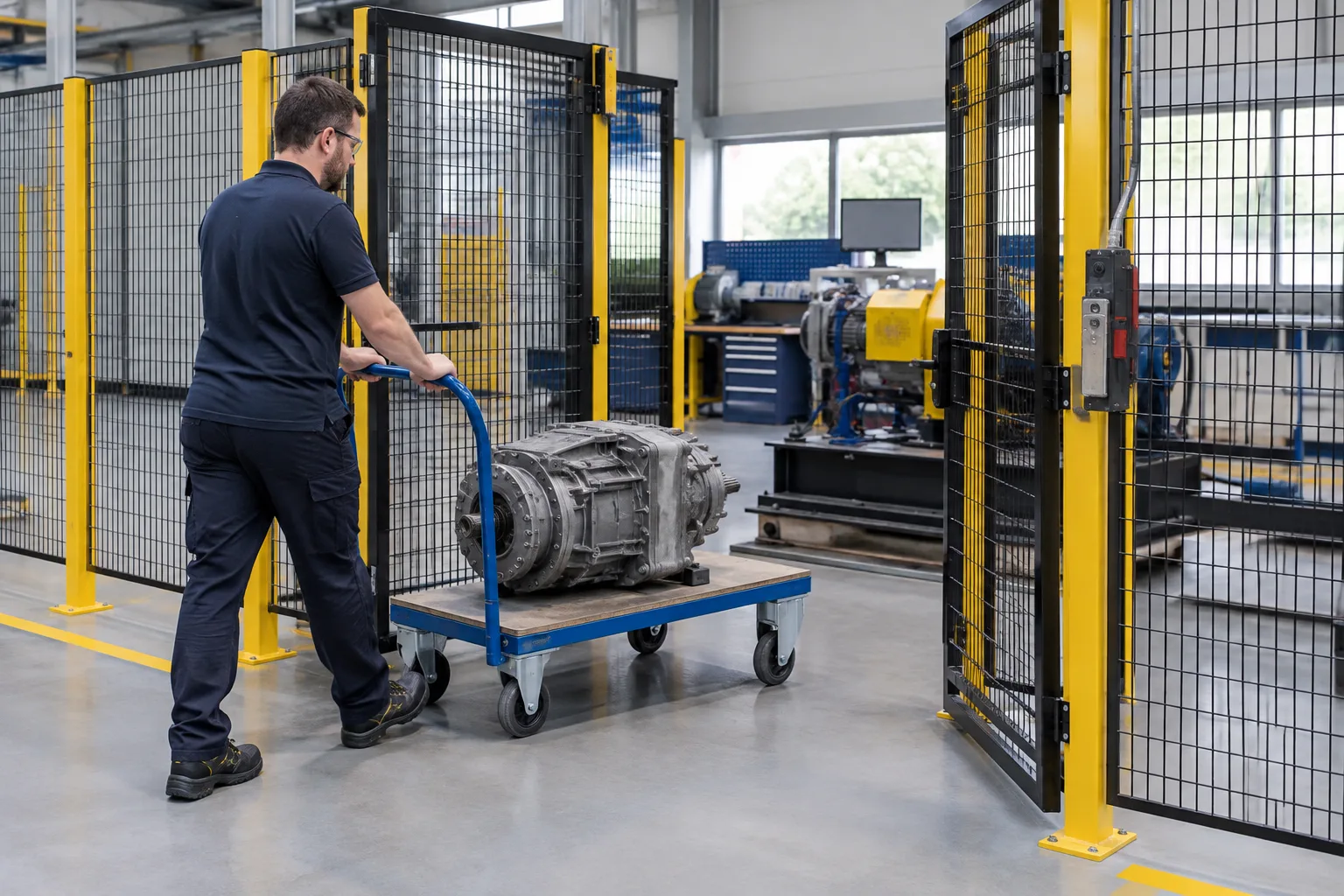
Test benches are entered far more often than production machines. A guard that is awkward to open tends to get propped open or bypassed, so access should be planned around the real tasks your technicians perform.
Choosing the door type
- Single-hinge doors for personnel entry to instrumentation, sensors and fluid connections
- Double-hinge doors where engines, gearboxes or fixtures are loaded by crane, forklift or trolley
- Folding doors where floor space in front of the bench is limited
- Bolted removable panels for infrequent major access, kept as fixed guards that need a tool to remove
When to interlock
Where a door is opened routinely and the rig remains hazardous while running or slowing down, an interlock linking the door to the control system is generally appropriate. ISO 14119 deals with interlocking devices associated with guards. Rundown time matters on test benches: a heavy flywheel or dynamometer may keep turning after a stop command, so guard locking until standstill may be required. The control logic is designed with your rig builder, while we supply the doors, locking arrangements and mounting hardware. See our range of door panels and connecting accessories for the options.
Building the enclosure from modular components
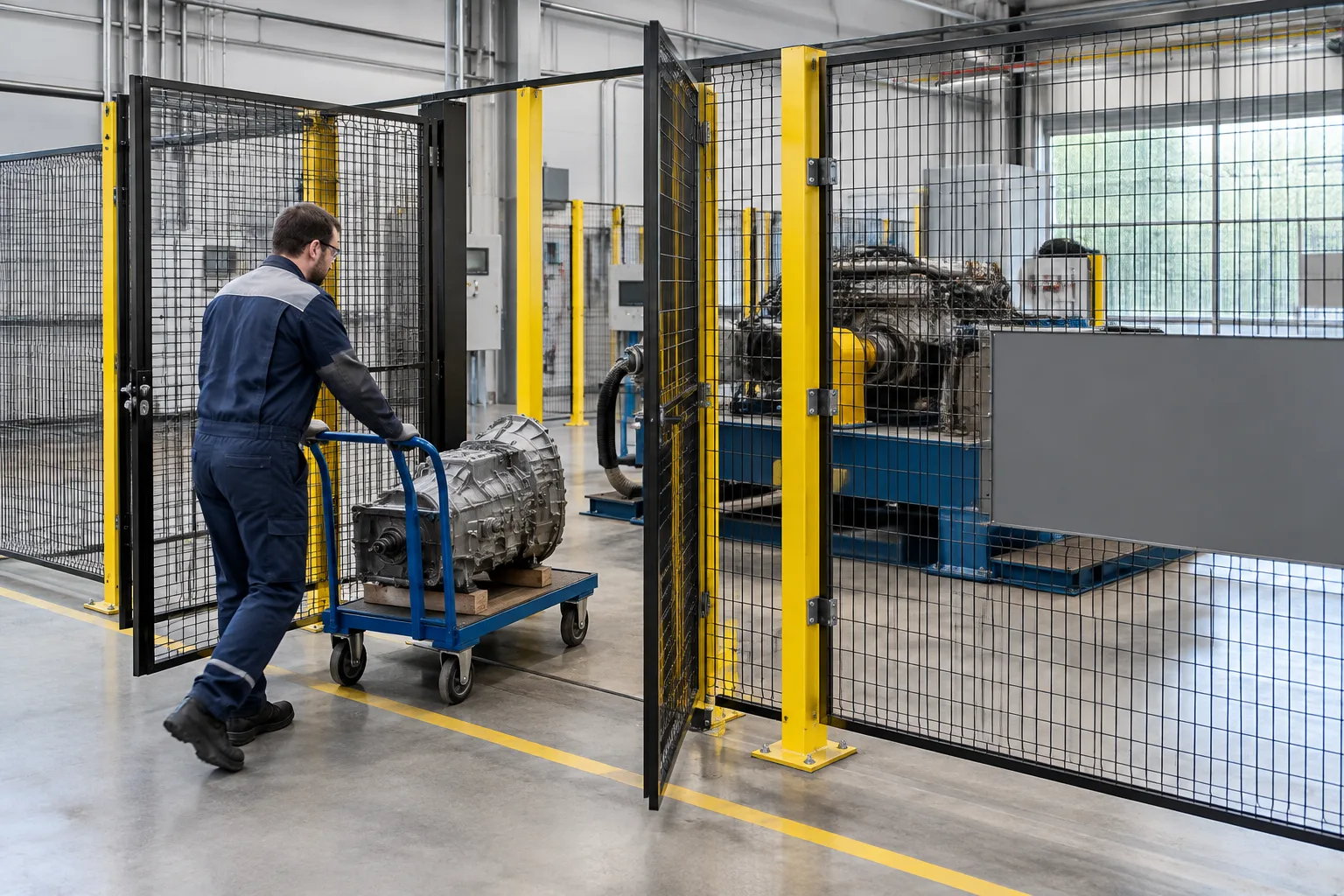
Test cells change whenever a new test article arrives, so a modular machine enclosure for a test bench usually outlasts a welded one. Our range covers the 40x40 column series and 40x60 column series, 20x100 mesh panels (with 20x100x3 mm specifications published for the applicable product), connectors, locks, doors and powder-coated finishes in multiple colours. The choice between 40x40 and 40x60 columns depends on fence height, panel span and the configuration specified, including the ARAI-tested configurations where that evidence matters to your safety file. If you are weighing a fully fabricated guard against a bolted system, our overview of custom and modular machine guards explains the trade-offs.
Many plants use the same system to separate test bays from adjacent stores and spares areas, which falls under our warehouse fencing range. One supplier for both keeps components interchangeable.
Test rigs also vibrate more than most equipment. Floor anchors, connectors and door alignment should be checked on a regular schedule, as covered in our guide to industrial safety fencing maintenance.
What to send for a test rig safety guarding quotation
For plants looking for industrial safety fencing in Pune and across Maharashtra, a quick and accurate quotation starts with good inputs:
- A layout drawing of the bench, dynamometer, control desk and surrounding aisles
- The test articles, with operating speed, power or torque range
- Your risk assessment findings, especially identified ejection and entanglement hazards
- Access tasks, how often they happen and how test articles are loaded
- Whether interlocks, guard locking or access control are needed, and who supplies the control system
- Site constraints such as floor condition for anchoring, overhead cranes and the available shutdown window
Fencing is one part of the safety design. The suitability of any test rig safety guarding must be assessed against the rig's hazards, together with its controls, installation and maintenance. Share your machine layout, drawings and access requirements with our technical team through our contact page to discuss your test bench and request a quotation.
Frequently asked questions
Can wire mesh fencing contain parts ejected from an engine or gearbox test rig?
Mesh fencing is primarily a perimeter barrier that keeps people out of the hazard zone. Swiza Safetech publishes ARAI impact inspection information for specified 40x40 and 40x60 configurations, but those results apply only to the configurations and conditions tested. High-energy failures usually need containment at the source, solid infill panels or greater stand-off, decided through risk assessment.
Does safety fencing reduce noise from a test bench?
No. Open wire mesh lets sound pass through and is chosen for visibility and ventilation. Noise control needs acoustic enclosures, an acoustic test cell or exposure controls, and mesh fencing can work alongside these for approach zones and segregation.
Do test rig access doors need interlocks?
Where a door is opened routinely and the rig can still be hazardous while running or slowing down, an interlock is generally appropriate. Rigs with long rundown times may also need guard locking until standstill. The control integration is designed with the rig builder, while Swiza Safetech supplies doors, locks and mounting arrangements.
Can guarding be added to an existing test bench?
Yes. Modular column and mesh panel systems are well suited to retrofits because they are bolted together and anchored to the existing floor. Share your layout and shutdown window so the enclosure can be planned around the rig and its services.
Do you supply test rig guarding outside Pune?
Swiza Safetech manufactures at Bhosari MIDC, Pune, and serves Pimpri-Chinchwad, Chakan, Talegaon, Ranjangaon, Mumbai, Navi Mumbai and the wider Maharashtra region. For other locations, contact the team with your project details.
