- Get in Touch
- +91 96840 33261
- Location
- Pune Maharashtra India
- Mail Us
- sales1@swizasafetech.in
Robot Cell Fencing Layout: How to Size the Fence Line From Reach, Tooling, Stopping Distance and Load Stations
- Swiza Safetech
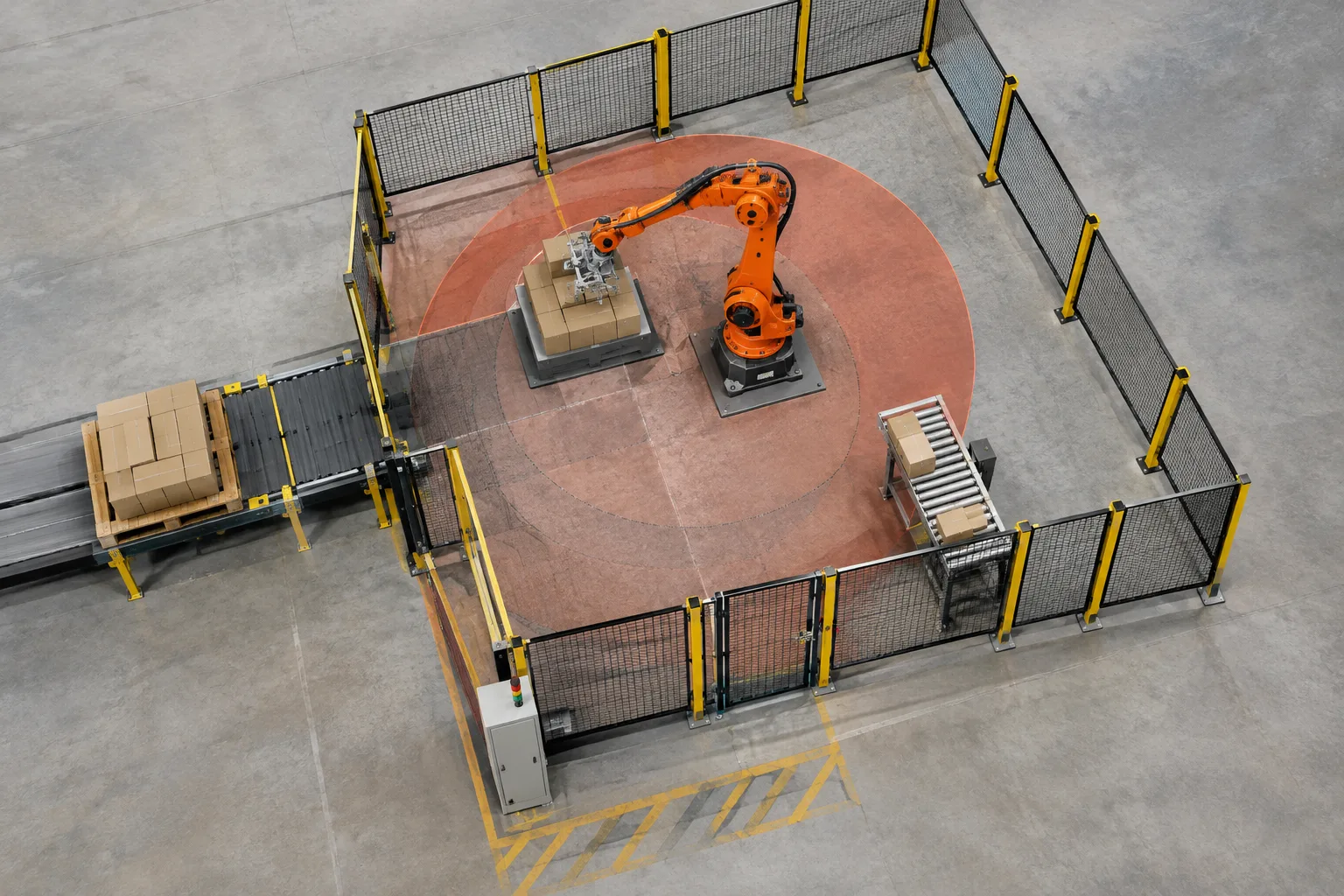
A robot cell fencing layout is sized outward from the robot's restricted space: the reach envelope of the arm, plus the tool and the largest part it carries, plus any clearance needed for the robot to stop before a person can reach the hazard. Load stations, conveyor openings and access doors are then placed on that fence line so operators work outside the hazard zone. Finally, fence height and mesh opening size are checked against reach-over and reach-through distances.
Swiza Safetech manufactures robot safety fencing at Bhosari MIDC, Pune, for robotics integrators, machine builders and plants across Pimpri-Chinchwad, Chakan, Talegaon and Ranjangaon. This guide follows the same sequence our design team uses when converting a robot layout into a fence line, so you can check a drawing before it goes out for quotation. It supports, but does not replace, the risk assessment and safety design for your specific cell.
Step 1: Map the robot reach envelope and restricted space
ISO 10218-1 and ISO 10218-2, the international standards for industrial robots and robot systems, separate three zones that matter for any robot fence. The maximum space is everything the manipulator, end effector and workpiece can sweep. The restricted space is the portion of that maximum space limited by mechanical stops or safety-rated axis and space limiting. The operating space is what the current program actually uses.
The fence line is drawn around the restricted space, not around the taught path. Programs get edited, new part variants arrive and a robot that only uses 120 degrees of base rotation today may be reprogrammed tomorrow. If no safety-rated limiting is configured, size from the full maximum space.
- Take the reach envelope drawing from the robot manufacturer's datasheet, in plan and elevation.
- Mark axis 1 rotation limits and whether they are enforced by hard stops or by the safety controller.
- Note the robot base height and any riser, track or positioner, since these shift the envelope.
Step 2: Add the tool and part envelope
Datasheet envelopes usually reference the wrist flange or a defined wrist point, not the tip of your gripper. Every millimetre of tooling and payload extends the swept volume beyond the published figure.
- Tool length: grippers, vacuum frames, welding torches, spindles and tool changers.
- Dress pack: cable bundles and hoses that swing outside the arm profile.
- Largest part, worst orientation: a long sheet metal blank or a body panel rotating at full extension often defines the true envelope.
- Process hazards: in robotic welding cell fencing, arc glare and spatter usually call for welding screens or solid infill panels along with the mesh perimeter.
Step 3: Allow for stopping distance and stopping time
A robot does not stop the instant a door opens or a light curtain is broken. ISO 10218-1 requires robot manufacturers to provide stopping time and stopping distance information, and those values grow with speed, payload and arm extension. This affects your robot cell fencing layout in two places.
First, where the restricted space relies on safety-rated software limits, the robot's overtravel during a stop must still stay inside the fence. Second, at every interlocked door or sensor-protected opening, ISO 13855 sets out how to calculate the minimum distance between the safeguard and the hazard using human approach speed and the overall stopping performance of the system. If a person could reach the robot before it has stopped, the options are to move the opening further away, reduce speed in that zone, or fit guard locking so the door stays closed until motion has ceased. Our guide to robotic fencing standards explains how these documents fit together.
Swiza Safetech designs and supplies the physical barrier. The stopping performance and the safety-related control system remain part of the integrator's risk assessment and guarding design.
Step 4: Position load stations, conveyors and access doors
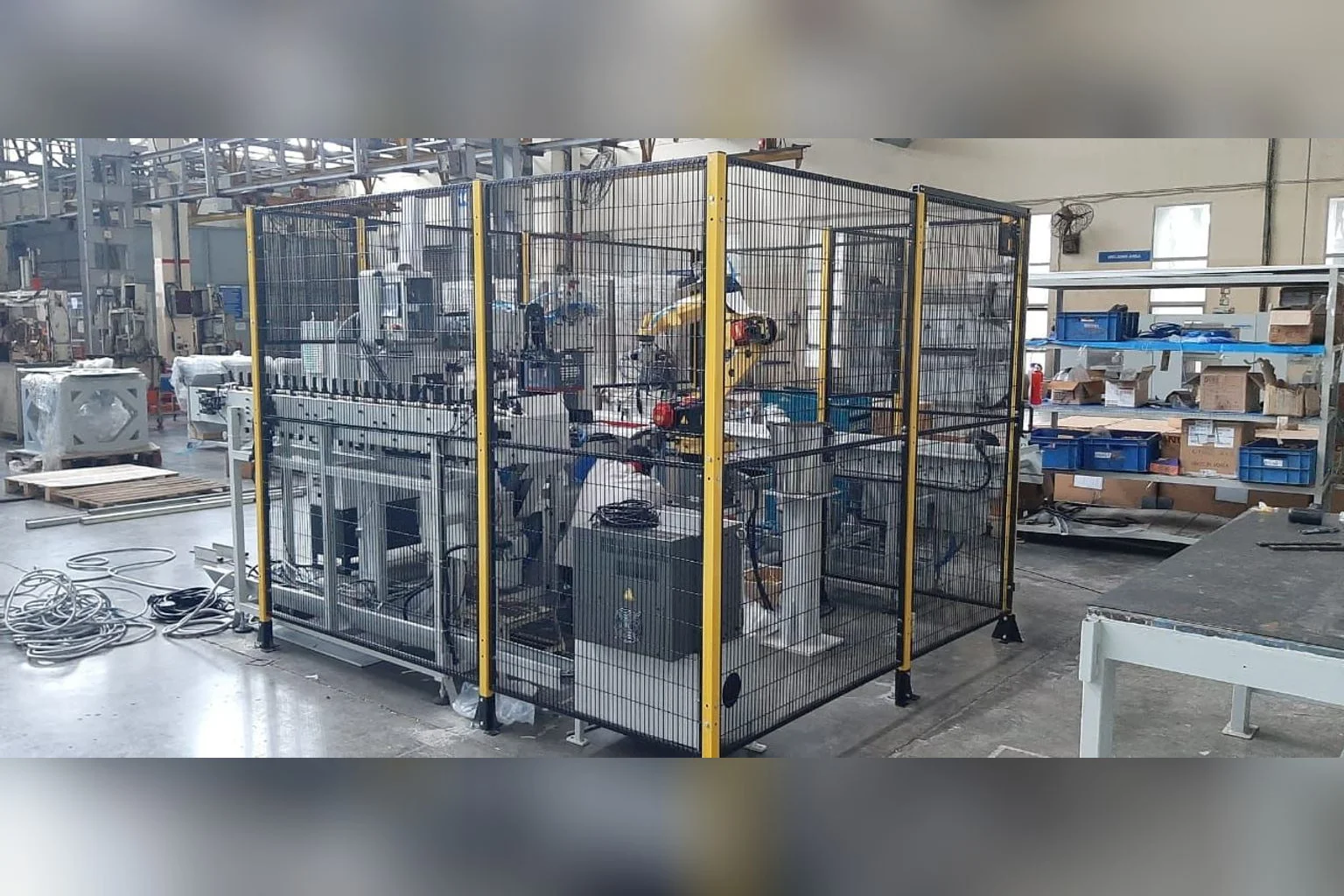
Once the hazard zone is defined, the fence line is shaped around how people and material actually enter the cell. This is where most layouts change after the first review.
Manual load stations
Two-station fixtures, turntables and shuttle tables let an operator load one side while the robot works on the other. The fence should return to the fixture so the operator stands outside the guarded space, with the open loading face protected by the turntable divider, a light curtain or a sliding or folding door as the risk assessment requires.
Conveyor infeed and outfeed openings
Openings for conveyors should be no larger than the product needs. Tunnel guards that extend the fence along the conveyor increase the distance to the robot and make it harder to reach in. Palletizer cells typically combine pallet entry openings with sensing and muting arrangements.
Maintenance and teach access doors
Place doors where maintenance actually happens: near tool changers, grippers and the controller, not in the corner that happened to be free on the drawing. Choose single-hinge doors for personnel access, double-hinge doors where fixtures or pallets must pass, and folding doors where swing space is tight. Check that door swing does not enter the robot path or block an aisle.
Fence height, mesh openings and reach-over distance
ISO 13857 gives safety distances to prevent hazard zones being reached by upper and lower limbs, both over the top of a barrier and through its openings. Fence height and the distance from the fence to the hazard work together: a lower fence needs more distance, and larger mesh openings need more set-back. Gaps at floor level must also be considered.
Our 20x100x3 mm mesh panel specification is published for the applicable product, which lets engineers check the opening size against the reach-through tables. For worked examples of height and set-back, see our perimeter safety fencing height and safety distance guide. Our website also references ISO 14120:2015, which covers general requirements for the design and construction of fixed and movable guards.
Robot fencing systems: columns, panels and doors
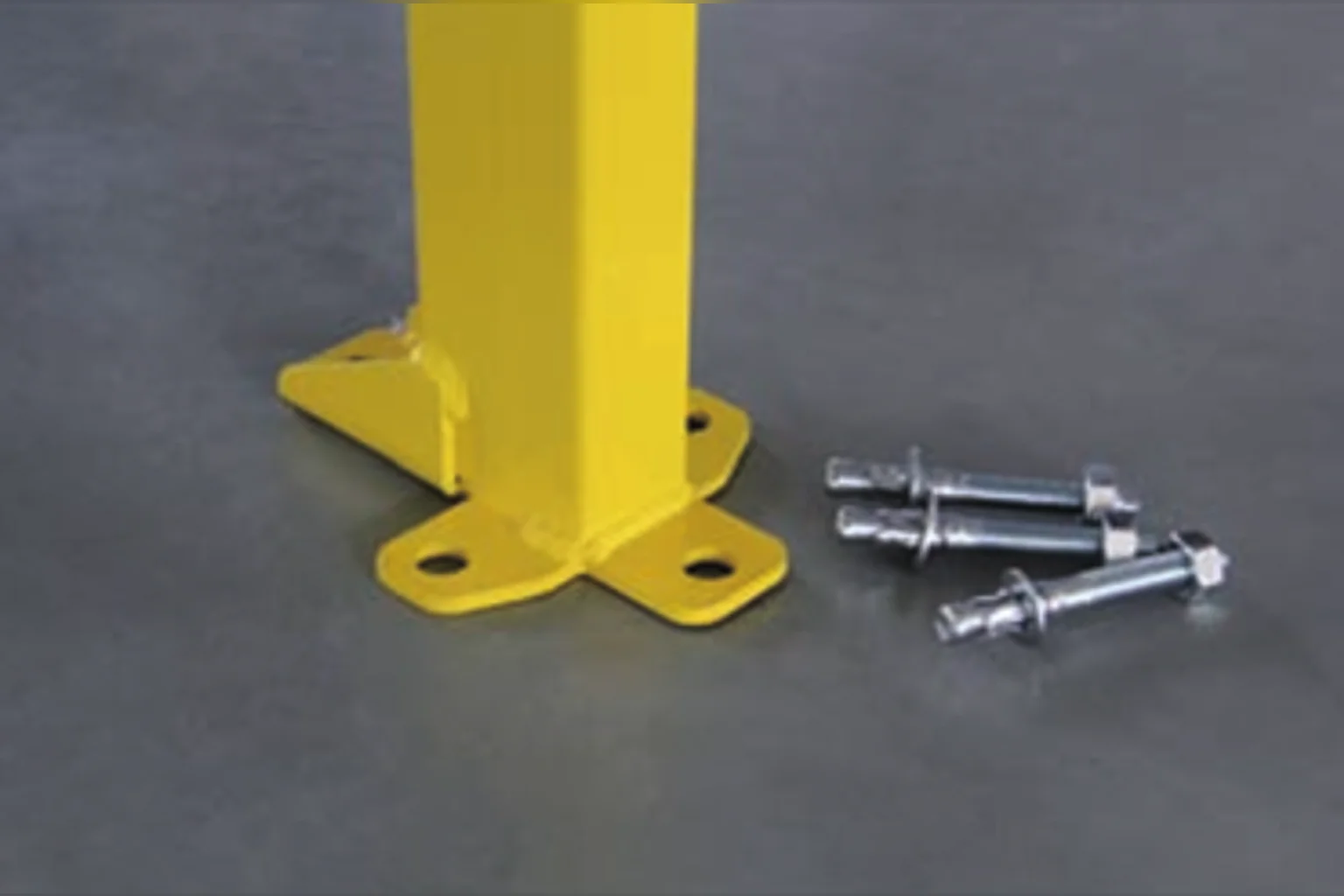
Swiza Safetech's robot fencing systems are modular: steel wire mesh panels, 40x40 and 40x60 column series, safety doors, locks and connectors, with powder-coated finish options. Our published catalogue lists standard fencing heights and panel widths, and in-house design support adapts these to project-specific layouts.
The 40x40 column series suits most standard robot cell perimeters. The larger 40x60 section is generally considered for taller fence lines, longer spans or areas where heavier contact or door loads are expected. Our product literature describes impact testing of specified 40x40 and 40x60 configurations, with ARAI inspection reference FMCE/3100015707(22-23)/SS/548(22-23). That test applies to the configurations described, so share your layout and we will confirm which configuration applies. You can see the full range on our robotic fencing cell page, and our overview of robotic cell safety fencing covers wider applications including robot line safety guarding.
Common robot cell fencing layout mistakes
- Sizing the fence from the taught path instead of the restricted space.
- Using the datasheet envelope without adding tool, dress pack and part.
- Placing interlocked doors without checking stopping time against the distance to the hazard.
- Oversized conveyor openings that allow reach-in.
- Forgetting overhead cranes, columns, trenches and uneven floors that affect anchoring and panel layout.
- No allowance for future changes, which modular fencing can accommodate if planned early.
What to share for a robot cell safety fence quotation
- Cell layout drawing (DWG or PDF) with robot base position and surrounding equipment.
- Robot make, model, payload and any track or positioner.
- Tool dimensions and the largest part handled.
- Safety-rated axis or space limiting settings, if configured.
- Load station type, conveyor openings and material flow direction.
- Door locations, door type and interlocking or guard locking requirements.
- Fence height preference, finish colour and floor conditions.
- Installation timeline, including any planned shutdown window.
For robot cell fencing in Pune and across Maharashtra, our team can review your layout and propose a fence line, door positions and column series. Share your machine layout with our team to request a quotation.
Frequently asked questions
How far should a robot safety fence be from the robot?
There is no single figure. The distance depends on the robot's restricted space including tooling and part, the fence height and mesh opening size under ISO 13857, and, at interlocked openings, the robot's stopping time under ISO 13855. Your risk assessment should confirm the final distance for each side of the cell.
Can I size robot cell fencing from the robot's programmed path?
It is not recommended. Programs change, so the fence should enclose the restricted space defined by hard stops or safety-rated limiting, or the full maximum space if no limiting is configured. Always add the tool and largest part to the datasheet envelope.
Should I choose the 40x40 or 40x60 column series for a robot cell?
The 40x40 column series suits most standard robot cell perimeters. The 40x60 section is generally considered for taller fences, longer spans or higher expected loads. Share your layout and our team will recommend the configuration for your cell.
Can robot fencing be modified if the cell layout changes later?
Yes. Swiza Safetech's modular panels, columns and connectors can be reconfigured, extended or fitted with additional doors. Any change to the fence line should be checked again against the robot's restricted space and safety distances.
