- Get in Touch
- +91 96840 33261
- Location
- Pune Maharashtra India
- Mail Us
- sales1@swizasafetech.in
Safety Interlock for Guard Doors: Choosing the Right Type by Application
- Swiza Safetech
A safety interlock for guard doors monitors whether a movable guard is closed. If the door is opened, it sends a stop command so the hazardous machine function cannot run. Choosing between a tongue switch, a non-contact sensor, solenoid guard locking or a trapped-key system depends mainly on how often the door is opened, how long the machine takes to stop, how tempting it is to defeat the device, and whether people can walk fully inside the guarded area.
This guide compares the four interlock types by application, with typical choices for robotic cells, conveyors, palletizers and test rigs. It is written for plant engineers, robotics integrators and EHS teams specifying safety fence doors in Pune, Chakan, Pimpri-Chinchwad and across Maharashtra.
What is the purpose of an interlocking guard?
An interlocked guard is a movable guard, such as a hinged or sliding fence door, connected to the machine control through an interlocking device. ISO 14120:2015 covers the general design of fixed and movable guards. ISO 14119 deals specifically with the design and selection of interlocking devices associated with guards. In practical terms, an interlocking guard on machinery should do three things:
- Stop the hazard when opened: opening the door issues a stop command to the hazardous function.
- Prevent start while open: the machine cannot start while the guard is open.
- Not restart on closing: closing the door should not, by itself, restart the machine. A separate, deliberate start action is normally required.
Guard locking adds a fourth function. The door stays locked shut until the hazard has stopped, which matters on machines that keep moving after the stop command. If you are still deciding whether a door needs to be movable at all, our comparison of fixed guards vs interlocked guards explains when a fixed guard is the simpler and safer answer. You can also see how we approach interlocking guards within our machine guarding systems.
Four questions to answer before choosing a fence door interlock
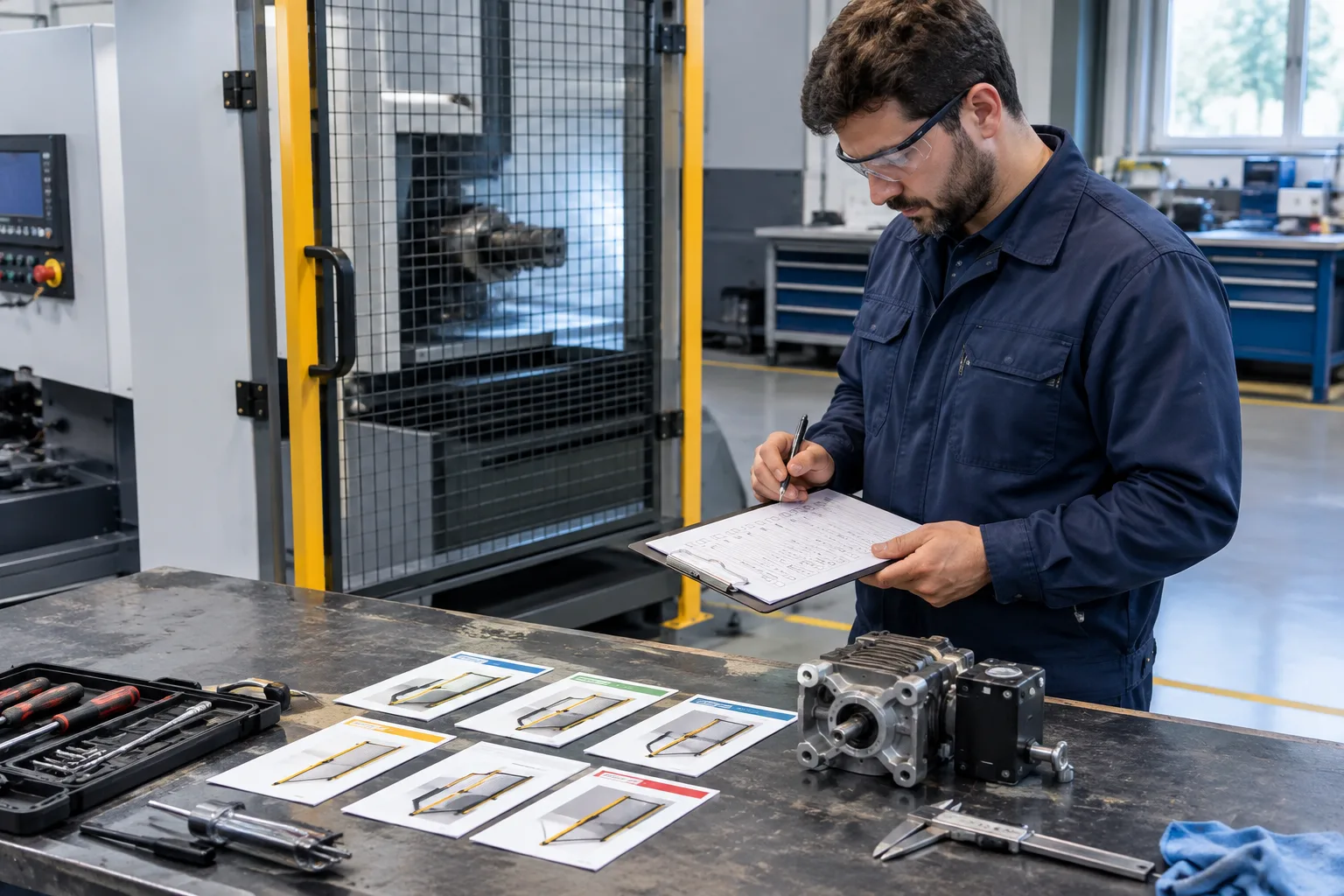
- How often is the door opened? A door used every cycle for loading parts needs a device that tolerates heavy use and slight misalignment. A maintenance door opened once a week does not.
- Can a person reach the hazard before it stops? Compare the machine's stopping time with the time a person needs to reach the danger zone after opening the door. ISO 13855 sets out approach speeds and distance calculations for this. If the machine stops too slowly, you need guard locking, not just position monitoring.
- How motivated are operators to defeat it? Frequent access, awkward adjustments and production pressure all increase the temptation to bypass. That pushes you towards higher coding or concealed mounting.
- Is whole-body access possible? If a person can step fully inside a robotic cell or palletizer enclosure, the system must stop someone else restarting the machine while they are inside.
The environment matters too: coolant, chips, weld spatter, dust and washdown all affect device life. The required performance level (PL), determined through risk assessment under ISO 13849-1, decides how the interlock is wired and monitored.
Interlocking machine guard types compared
Tongue switches (coded mechanical actuators)
A tongue switch has a separate actuator, the tongue, mounted on the door. It enters the switch head mounted on the fence column or frame. ISO 14119 classifies this as a Type 2 device (coded, mechanically actuated). Tongue switches are economical and simple to wire, and the hidden actuator geometry makes them harder to cheat than a plain limit switch.
Their weakness is alignment. A door that sags or a frame that flexes will eventually misalign the tongue, and repeated slamming wears the head. Spare actuators are also easy to obtain, so the coding level is usually low. Tongue switches suit doors opened infrequently on machines that stop quickly, such as conveyor maintenance doors and small access panels.
Non-contact coded sensors (RFID and coded magnetic)
Non-contact sensors detect a coded target on the door without physical engagement. ISO 14119 classes them as Type 3 (uncoded) or Type 4 (coded) devices. It also defines coding levels as low (1 to 9 code variations), medium (10 to 1,000) and high (more than 1,000). An RFID sensor taught to one unique actuator gives high coding, which makes substitution with a spare target ineffective.
Because nothing touches, these sensors tolerate misalignment, vibration and washdown well. They are a strong choice for frequently opened doors, such as robot loading doors and packaging line access. They provide no holding force, however. The door can be opened at any moment, so they are only suitable where the machine stops before a person can reach the hazard.
Interlocking magnets: safety sensor or door catch?
Searches for "interlocking magnets" often mix up two different products. A coded magnetic safety sensor is a monitored safety device wired into the safety circuit. An ordinary magnetic catch only holds a door closed against vibration or swing. It provides no safety function and must never be treated as an interlock. Our guide to magnetic door catches for fence doors covers where catches are useful alongside a proper interlock.
Solenoid guard locking switches
A guard locking switch is effectively an electric door lock for a machine guard. It keeps the door locked until a standstill monitor, safe timer or robot controller confirms the hazard has ceased. There are two principles:
- Spring-applied, power-to-release: the door stays locked if power fails. This is generally preferred where loss of power must not release the guard on a running-down machine.
- Power-to-lock: the door unlocks when power is removed. This is sometimes used for process protection or low-risk applications.
Spring-applied locking needs an escape release on the inside of a walk-in enclosure and an auxiliary release for rescue or maintenance. Typical applications include machines with long rundown times, high-inertia robots, spindles, centrifuges and test rigs with stored energy. A guard locking switch is a safety device rated for this duty. It is not the same as a general security lock.
Trapped-key interlock systems
Trapped-key systems use mechanical key transfer. An isolation key is released from the control panel or isolator only when power is switched off. That key opens the door lock, and the door releases a personal key the operator carries inside. While the personal key is out, the machine cannot be restarted. Trapped-key systems suit large cells with several entry points, maintenance access with full-body entry, and plants where wiring a door switch to a distant controller is impractical. They are slower to use, so they are a poor fit for frequent production access.
Interlocks for robotic systems and other interlocked guard examples
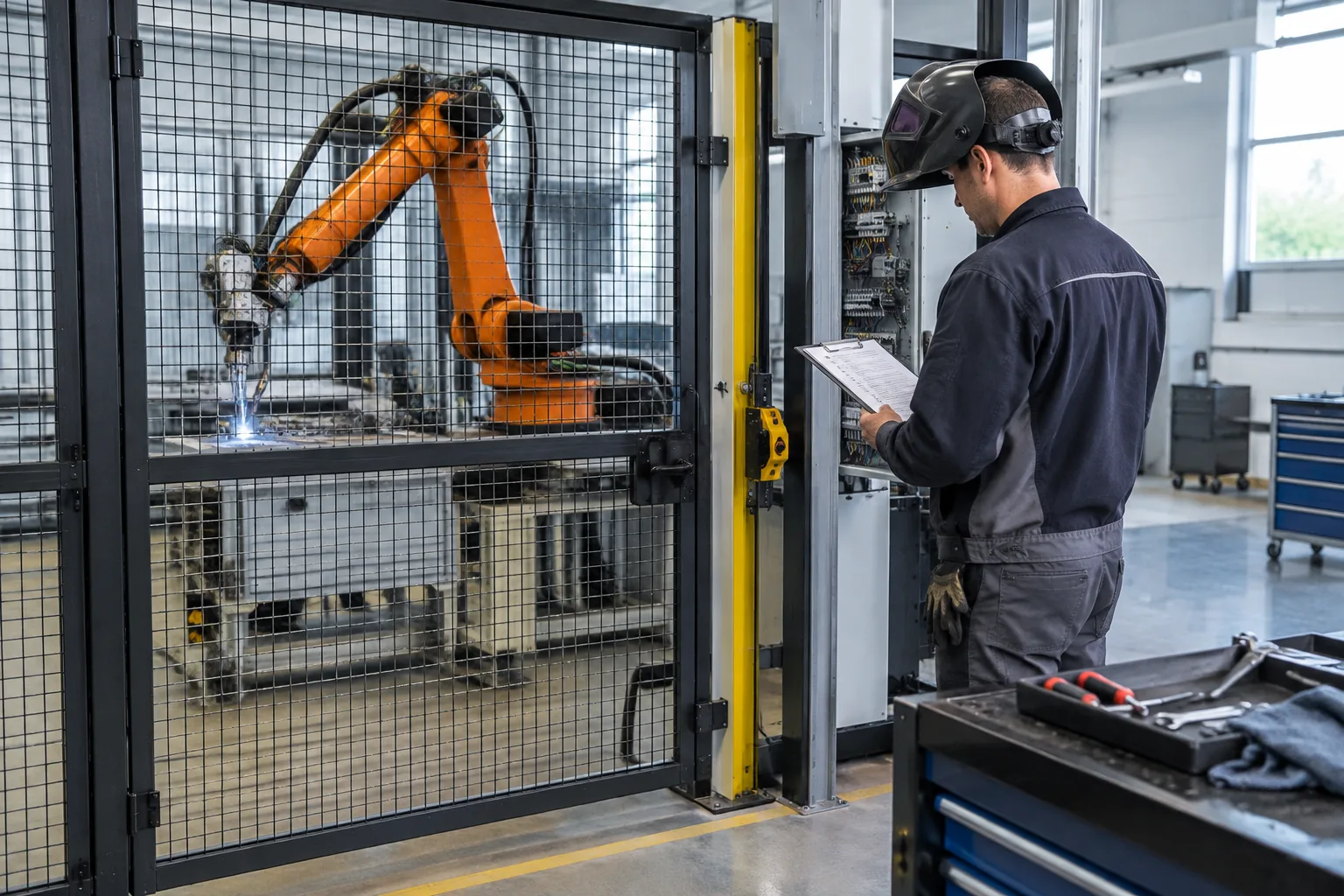
ISO 10218-2 addresses the integration of industrial robot systems, including safeguarding. In robotic cells, the interlock choice is driven by stopping performance and whether the operator enters the cell. Typical interlocked guard examples we see on projects include:
- Robotic welding cell operator door: guard locking with a coded actuator, plus an internal escape release.
- Robot part-loading door opened every cycle: a high-coded RFID sensor, provided the robot stops before the operator can reach it. Otherwise, guard locking.
- Palletizer maintenance door with walk-in access: a trapped-key system or guard locking with personal lockout provision.
- Conveyor inspection hatch: a tongue switch or non-contact sensor on a fast-stopping drive.
- Test rig enclosure: guard locking until pressure, rotation or stored energy has dissipated.
These are typical starting points, not prescriptions. As we tell every client, the suitability of a guarding system must be assessed against the machine's hazards and the complete safety design.
Matching the interlock to the safety fence door
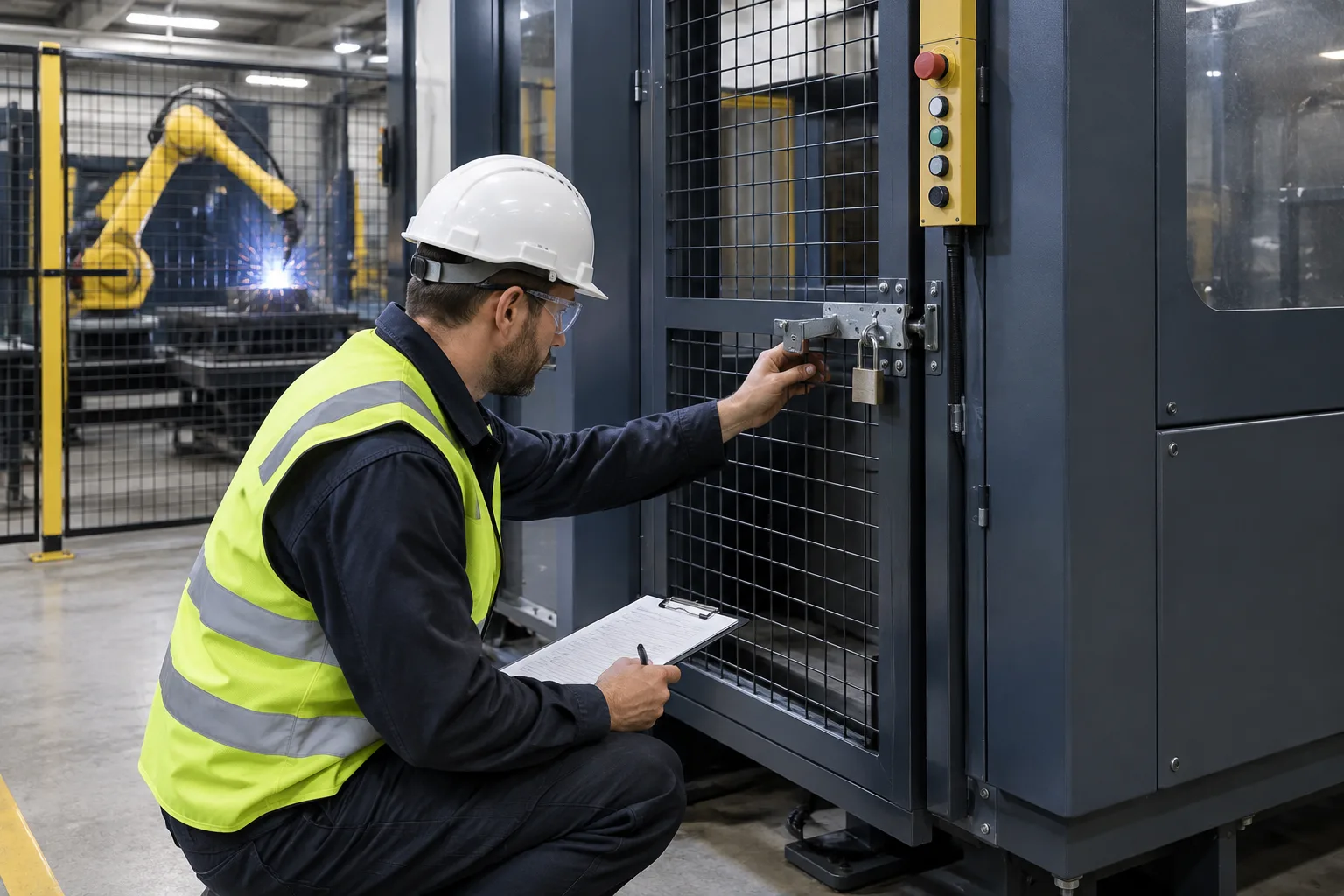
An interlock is only as dependable as the door and fence it is mounted on. A door that drops on its hinges will misalign a tongue actuator. A flexible frame can let a guard locking switch hold while the panel itself moves. Door style changes the mounting too. Single-hinge, double-hinge, folding and sliding doors each need different switch and actuator positions. You can explore the range of machine safety doors and accessories, and our article on sliding and folding safety doors compares those two layouts.
Swiza Safetech manufactures modular fencing on 40x40 and 40x60 column series with steel mesh safety panels, hinges, connectors and locking arrangements. Our published product literature describes impact testing of specified 40x40 and 40x60 configurations under ARAI impact inspection reference FMCE/3100015707(22-23)/SS/548(22-23). When planning an interlocked door, we look at:
- Rigid door framing and hinge choice to hold alignment over repeated cycles
- Mounting surfaces on the column for the switch head or sensor
- Handle position and padlock provision for lockout
- Clearance for escape releases on walk-in enclosures
Getting the selection right for your machine
Selecting a safety interlock for guard doors is part of the machine's overall safety design. That means risk assessment, stopping-time measurement, the required performance level and correct wiring into the safety circuit. The device itself is usually specified by the machine builder, integrator or safety consultant. Our role, as a machine safety fencing manufacturer in Pune operating from Bhosari MIDC, is to make sure the fence, door and mounting arrangement suit that device and stay aligned in service.
If you are building a robotic cell, guarding a conveyor or retrofitting an existing line, share your machine layout, door positions and the interlock type your safety design calls for. Our technical team can propose a project-specific door and fencing arrangement. Contact Swiza Safetech to share your drawings and request a quotation.
Frequently asked questions
What is the difference between an interlocked guard and guard locking?
An interlocked guard detects when the door is opened and stops the hazardous function, but the door can be opened at any time. Guard locking also keeps the door locked shut until the hazard has stopped. Guard locking is needed when the machine takes longer to stop than a person takes to reach the hazard.
Is a magnetic door catch the same as an interlocking magnet sensor?
No. A coded magnetic safety sensor is a monitored safety device wired into the machine's safety circuit. A magnetic door catch only holds the door closed against vibration or swing and provides no safety function. A catch can be used alongside a proper interlock, but never in place of one.
Which interlock is best for a robotic cell door?
It depends on the robot's stopping performance and how often the door is used. Frequently opened loading doors often use high-coded non-contact sensors where the robot stops quickly enough, while operator doors on cells with longer rundown typically use guard locking with an internal escape release. Large walk-in cells with several doors may suit trapped-key systems.
Does Swiza Safetech supply doors ready for interlock mounting?
Swiza Safetech manufactures single-hinge, double-hinge, folding and sliding safety fence doors along with locking arrangements and connecting accessories. Share the interlock device your safety design specifies, and our team can plan door framing, mounting positions and lockout provision around it.
Can interlocks be added to existing safety fence doors?
Often, yes, provided the existing door and frame are rigid and properly aligned. A sagging door or flexible frame can cause nuisance trips or allow the guard to move while locked. We recommend reviewing the door condition and mounting surfaces as part of any retrofit.
