- Get in Touch
- +91 96840 33261
- Location
- Pune Maharashtra India
- Mail Us
- sales1@swizasafetech.in
ISO 14120 Fixed and Movable Guards: What Indian Plants Need to Know About Design, Materials and Impact Testing
- Swiza Safetech
ISO 14120:2015 sets the general requirements for the design, construction and selection of fixed and movable guards that protect people from mechanical hazards on machinery. For ISO 14120 fixed and movable guards, it asks that guards be robust enough for the forces they will meet, securely fixed, suitable for the operating environment, and designed so they do not create new hazards or invite people to bypass them. Impact testing, such as the ARAI impact inspection published for specified Swiza Safetech fencing configurations, is one way to verify that a guard material and structure can resist the kind of impact a machine may produce.
This article explains what the standard actually covers, how it treats fixed and movable guards differently, and how Indian plant engineers can use impact test data sensibly when comparing guarding options. If you have not yet sized your guard height and openings, read our earlier guide on perimeter safety fencing height and safety distance first, because ISO 14120 relies on correct safety distances to work.
What ISO 14120 Machine Guarding Covers, and What It Does Not
ISO 14120 is a type-B standard in the ISO machinery safety framework. It sits beneath ISO 12100, which sets out the general principles of risk assessment and risk reduction, and alongside other standards that handle specific topics. In practice, ISO 14120 machine guarding requirements work together with three related documents:
- ISO 12100 for risk assessment, which decides whether a guard is needed and what it must protect against.
- ISO 13857 for safety distances, which determines how high a fence must be and how large mesh openings can be relative to the hazard.
- ISO 14119 for interlocking devices associated with guards, which covers the switches and locking mechanisms on movable guards.
ISO 14120 itself focuses on the guard: its type, construction, fixing, materials, and how its performance is verified. It does not, on its own, make a machine safe. A well-built fence placed at the wrong distance, or a door without an appropriate interlock, still leaves a gap in the safety design. This is why we always describe guarding as one layer within a complete industrial safety risk assessment, not a substitute for it.
Fixed Guards: Design and Construction Requirements
A fixed guard is held in place so that it can only be opened or removed with a tool, or is permanently fixed by welding. Typical examples are perimeter mesh fencing around a robotic cell, or enclosing panels around a drive or transmission.
For fixed guards, ISO 14120 places particular emphasis on how they are fastened:
- Tool-required removal. Fixings should need a tool to release, so that a guard cannot be casually lifted off by hand.
- Fixings that stay with the guard. Where a fixed guard is removed for maintenance, the standard expects its fixings to remain attached to the guard or the machine, so screws and bolts are not lost and the guard is not refitted with fewer fixings than designed.
- No unfixed stability. A fixed guard should not be able to stay in position without its fixings, so that a guard that looks secure but is actually loose is avoided.
- No new hazards. Edges, corners and mesh ends must not create cutting or trapping points of their own.
Fixed guards suit areas where access is rare, such as maintenance-only zones. Our machine guarding systems use column, panel and connector arrangements so that fixed sections can be removed with tools when needed and refitted to the same configuration.
Movable Guards: Access, Doors and Interlocking
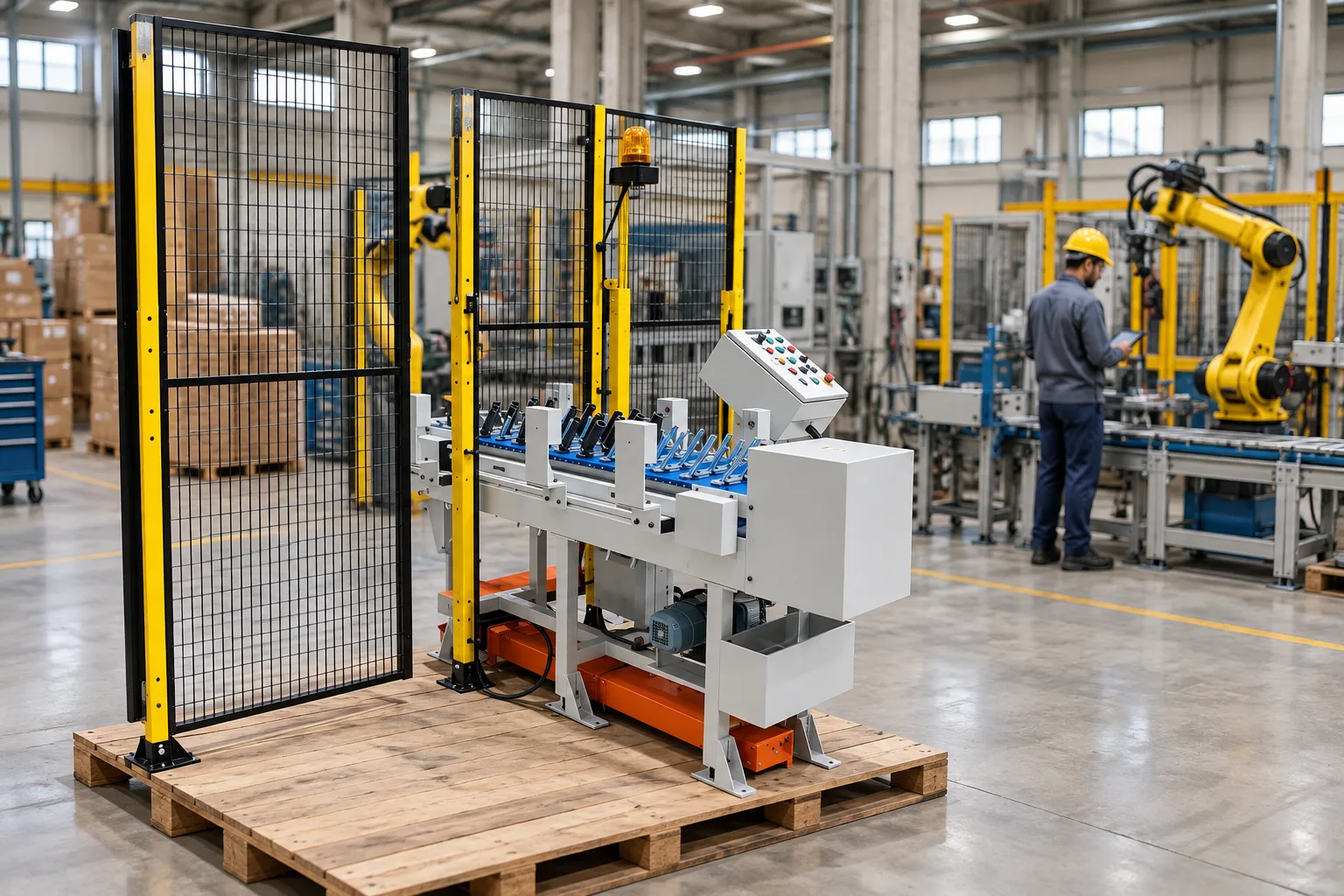
A movable guard can be opened without tools. Safety doors, sliding gates and folding doors in a fence line are all movable guards. Under ISO 14120, a movable guard should, as far as practicable, remain attached to the machine or fence structure when open, through hinges or guides, so it cannot be misplaced or left lying on the floor.
The key engineering question is how often people need to enter. Where access is frequent, such as loading parts, clearing jams or tool changes, a fixed guard becomes impractical, and operators will be tempted to remove it. A movable guard with an interlocking device, and guard locking where the hazard does not stop immediately, is generally the appropriate choice. ISO 14119 then governs how that interlock is selected and fitted. For a deeper comparison of the two approaches, see our article on fixed guards vs interlocked guards.
Movable guards also need practical design attention: handles at a sensible height, door weight that operators can manage, clearances that avoid crushing fingers at hinges, and enough opening width for the task being performed.
Materials and Structural Integrity
ISO 14120 does not prescribe a single material. Instead it asks the designer to consider the properties a guard material must have for its application. The main factors are:
- Impact resistance against ejected parts, tools or a moving robot arm.
- Stiffness and stability so the guard does not deflect into the hazard zone.
- Containment and visibility, balancing the need to see the process with the need to hold back debris, fluids or sparks.
- Durability and corrosion resistance in the actual plant environment, including coolant, washdown or outdoor exposure.
- Opening size, which must match the safety distance requirements of ISO 13857.
Steel wire mesh is widely used in industrial perimeter guarding because it combines visibility with strength. Swiza Safetech publishes specifications for 20x100x3 mm mesh panels on the applicable product, alongside 40x40 and 40x60 column series and powder-coated finish options. The right panel, column size and fixing arrangement depend on your machine's hazards, not on a catalogue default.
Where Impact Testing and an ARAI Test Fit Into Guard Selection
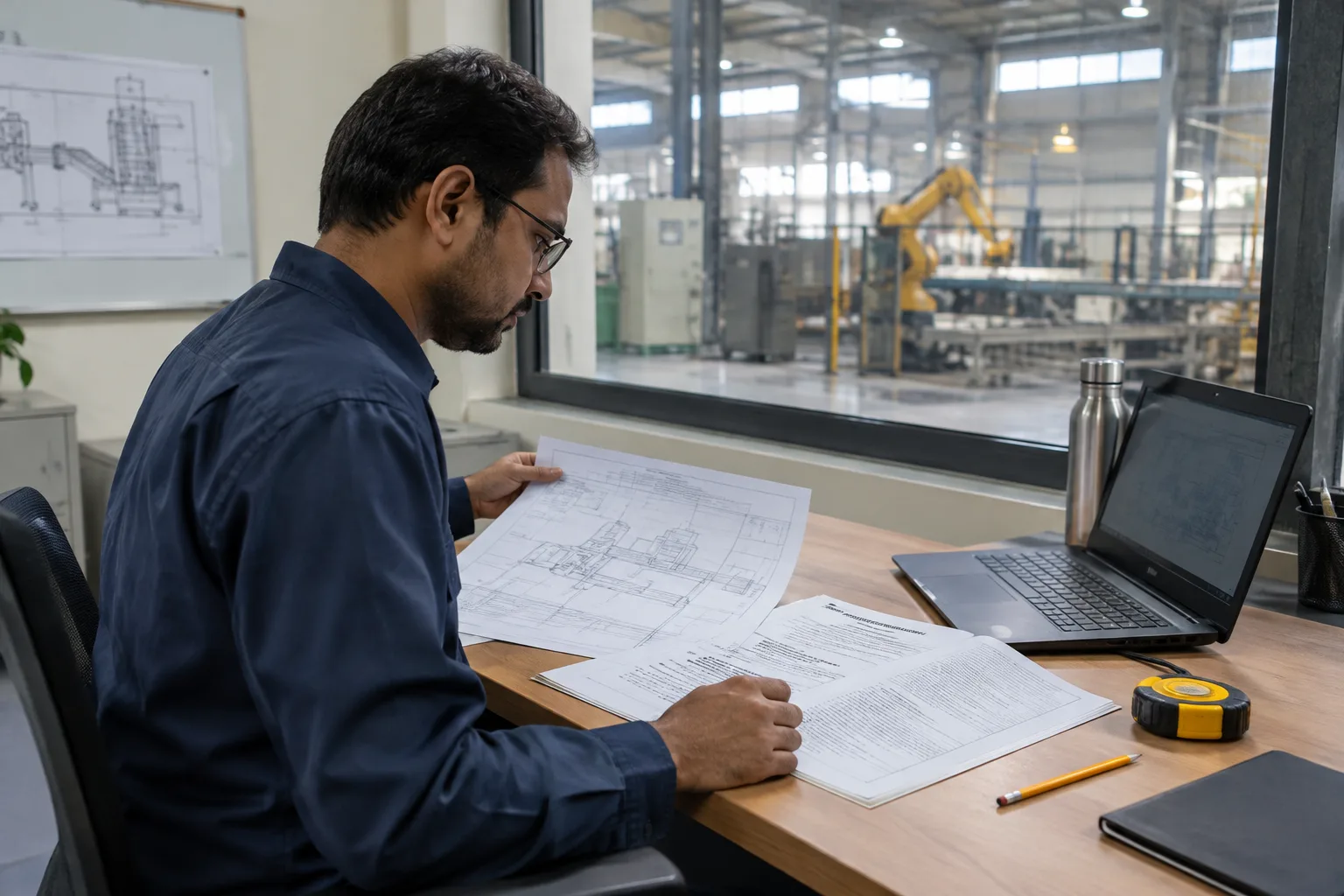
ISO 14120 lists verification methods for guards, and impact testing is one of them. The purpose is simple: to confirm that a guard can absorb or resist a defined impact without failing in a way that exposes people to the hazard.
For Indian buyers, ARAI tested safety fencing offers a checkable reference point. The Automotive Research Association of India, based in Pune, carries out testing for industry. Swiza Safetech's published product literature describes impact testing of specified 40x40 and 40x60 fencing configurations, under the ARAI impact inspection reference FMCE/3100015707(22-23)/SS/548(22-23).
Used correctly, impact test data helps you:
- Compare suppliers on evidence rather than on descriptions like "heavy duty".
- Match the tested configuration to your layout, because a result applies to the column size, panel, mesh and fixing arrangement that was tested.
- Check against your machine's actual hazard, such as robot payload and speed, or the mass of a part that could be ejected.
A test result is not a blanket approval. As we tell customers, "the suitability of a guarding system must be assessed against the machine's hazards and the complete safety design." If your application involves higher energies than the tested configuration, the guard specification may need to change.
Machine Guard Compliance Requirements in India
In India, the legal baseline comes from the Factories Act, 1948. Section 21 requires dangerous parts of machinery to be securely fenced by safeguards of substantial construction, kept in position while those parts are in motion. State factory rules add detail, and many plants also follow international standards because their customers, parent companies or export markets expect it.
ISO 14120 is useful here because it gives a structured way to define what "substantial construction" means for a specific guard. Our article on safety fencing for OSHA and ISO compliance in India covers how these frameworks are commonly applied in Indian factories.
How to Evaluate an ISO 14120 Compliant Fencing Manufacturer Claim
Many suppliers describe themselves as an ISO 14120 compliant fencing manufacturer. Since compliance applies to a guard in a specific application, ask practical questions:
- Which guard types and configurations does the claim refer to?
- Is impact test evidence available, and for which column, panel and fixing combination?
- How do the fixings behave when a fixed section is removed?
- What door, hinge and locking options are available for movable guards?
- Can the supplier design around your safety distances and access points?
For robotic applications, our ISO-compliance robotic cell fencing shows how these principles translate into a working cell layout.
Share Your Machine Layout for Project-Specific Guarding
Swiza Safetech manufactures industrial machine safety fencing at Bhosari MIDC, Pune, and supports plants across Pimpri-Chinchwad, Chakan, Talegaon, Ranjangaon and Mumbai. If you are planning new ISO 14120 fixed and movable guards or upgrading existing ones, share your machine layout, drawings, access requirements and hazard details with our technical team. Request a quotation and we will propose a project-specific machine guarding configuration.
Frequently asked questions
What is ISO 14120?
ISO 14120:2015 is an international machinery safety standard that sets general requirements for the design, construction and selection of fixed and movable guards. It focuses on protecting people from mechanical hazards and works alongside ISO 12100 for risk assessment, ISO 13857 for safety distances and ISO 14119 for interlocking devices.
What is the difference between a fixed guard and a movable guard under ISO 14120?
A fixed guard can only be removed with a tool or is permanently fixed, and suits areas where access is rare. A movable guard, such as a hinged or sliding door, opens without tools and is used where access is frequent. Movable guards usually need an interlocking device, selected under ISO 14119.
Does an ARAI impact test mean my fencing is approved for any machine?
No. An impact test result applies to the specific configuration that was tested, including column size, panel, mesh and fixings. You still need to compare that configuration against your machine's actual hazards, such as robot payload or ejected part energy, as part of your risk assessment.
Is ISO 14120 mandatory in India?
The legal baseline in India is the Factories Act, 1948, which requires dangerous machinery parts to be securely fenced with safeguards of substantial construction, plus applicable state factory rules. ISO 14120 is widely used as a technical reference to define how guards should be designed and built, and customers or export markets often expect it.
What information should I share to get machine guarding designed?
Share your machine layout or drawings, overall dimensions, hazard zones, access points and how often operators need to enter. Details such as robot reach, conveyor routes and floor conditions also help. This allows a project-specific fencing layout with suitable doors, columns and panels.
